
Posted by rootsbyga.shop
on October 12, 2026

TL;DR
A hair growth serum is a leave-on scalp treatment, but the category includes products with very different goals. Some temporarily thicken or condition strands; others claim to reduce shedding or support follicle activity. We recommend judging a serum by its intended outcome, human evidence, complete formula, tolerability, and realistic timeline—not by terms such as “natural,” “clinically proven,” or “doctor recommended.”
Table of Contents
- Hair Growth Serum: What It Is and What “Growth” Should Mean
- How to Read the Evidence Behind a Hair Growth Serum
- Peptide Hair Growth Serums: Proposed Benefits and Evidence Limits
- Minoxidil vs. Non-Drug Peptide Hair Growth Serum
- Which Hair Serum Ingredients Have Human Evidence?
- How to Choose the Best Hair Growth Serum for Your Needs
- How to Apply Hair Growth Serum Without Greasy Roots or Buildup
- Hair Growth Serum Results: Timeline, Tracking, and Side Effects
- When Hair Loss Needs a Clinician, Not Another Serum
- FAQ
- Choose a Hair Growth Serum Based on Evidence
Hair Growth Serum: What It Is and What “Growth” Should Mean
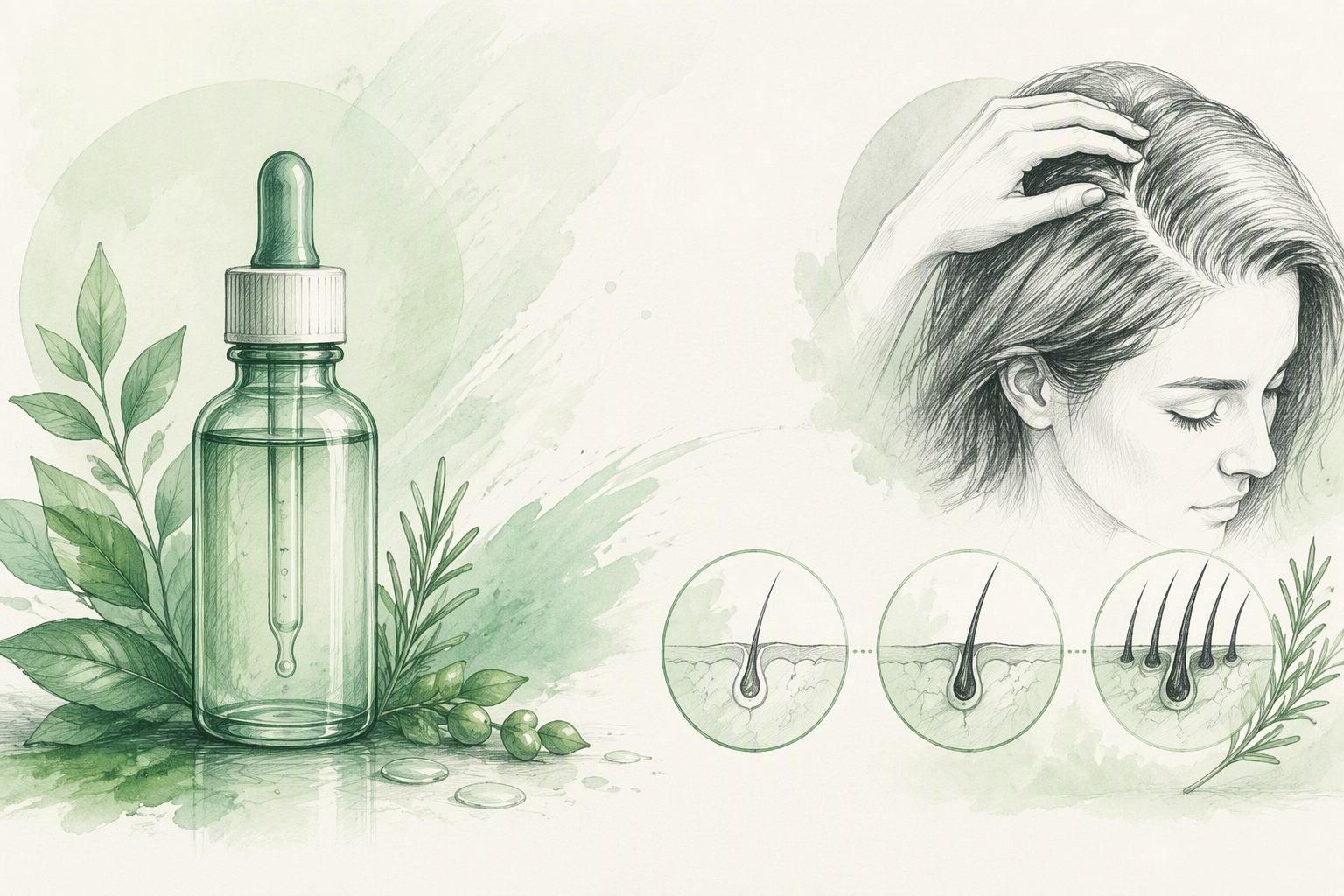
A hair growth serum is generally a leave-on scalp treatment marketed to reduce shedding, support follicles, encourage regrowth, or improve visible density. Those outcomes are not interchangeable.
Hair count, density, and shedding are biological measures. Shine, root lift, coated fibers, and temporary fullness are cosmetic effects. Both may be useful, but fuller-looking hair is not proof of new growth.
Product roundups often place scalp treatments, thickening products, and regrowth interventions in the same category. We take a different approach: assess what each product promises and whether the available evidence matches that promise.
Hair Growth Serum vs. Scalp Serum, Thickening Serum, and Cosmetic Serum
The label matters less than the intended result:
- A scalp serum may hydrate, soothe, or help manage oil.
- A thickening serum may coat fibers so strands appear wider.
- A cosmetic serum may improve shine, softness, or frizz.
- A growth-focused treatment should offer credible evidence related to shedding, density, hair count, or follicle activity.
A more comfortable scalp may support consistent care, but comfort alone does not demonstrate regrowth. Likewise, temporary fullness does not mean follicles are producing more hair.
For a broader framework, see our guide to separating hair growth product evidence from hype.
What Would Count as a Serum That Actually Works?
A serum works when it produces the specific outcome it promises. Relevant assessments may include standardized hair counts, density measurements, shaft diameter, shedding records, investigator evaluations, or validated participant reports.
Every clinical claim should explain:
- What changed
- How it was measured
- How long the evaluation lasted
- Who participated
- Whether researchers tested the marketed formula
Immediate softness or volume should not be presented as new growth. If a study only found that hair looked healthier, the conclusion should remain limited to appearance.
How to Read the Evidence Behind a Hair Growth Serum
The most relevant evidence usually comes from a well-designed human study of the exact finished formula. Evidence based on comparable formulas, individual ingredients, laboratory models, animals, or proposed mechanisms is less direct.
Concentration, delivery system, application schedule, study population, adherence, duration, comparator groups, and endpoints all affect how useful a study is. “Clinically proven” should begin the review, not end it.
Our evidence-first standard is straightforward: brands should disclose what a formula contains, what kind of evidence supports it, and what remains uncertain.
Finished-Formula Trials vs. Ingredient-Level Studies
A “tested ingredient” has evidence relating to that ingredient. A “tested finished formula” has been evaluated as the complete product, using a defined dose and schedule.
Ingredient research does not prove that every serum containing that ingredient works. Results may be affected by:
- Concentration and stability
- Interactions among ingredients
- The water-, alcohol-, or oil-based vehicle
- Scalp contact and application frequency
- Preservation and packaging
Brands should make clear whether cited research concerns the product itself, a comparable formula, or an isolated ingredient.
A Five-Question Clinical Claim Checklist
Before accepting a claim, we ask:
- Was the finished formula tested in humans?
- Was there a suitable control or comparator?
- Were outcomes measured objectively?
- Did the dose and schedule match the product directions?
- Were funding, limitations, and commercial relationships disclosed?
A claim without accessible methods, duration, participant information, or endpoints offers little basis for evaluation. The same applies when research uses an ingredient concentration that may not reflect the marketed product.
How to Judge Before-and-After Photos
Useful before-and-after images require consistent lighting, distance, angle, part placement, wash state, styling, and camera settings. Wet hair, a shifted part, added root lift, or a closer crop can change how much scalp is visible.
We treat photos as supporting material, not stand-alone proof. Controlled measurements provide a stronger basis for judging density or growth.
Peptide Hair Growth Serums: Proposed Benefits and Evidence Limits
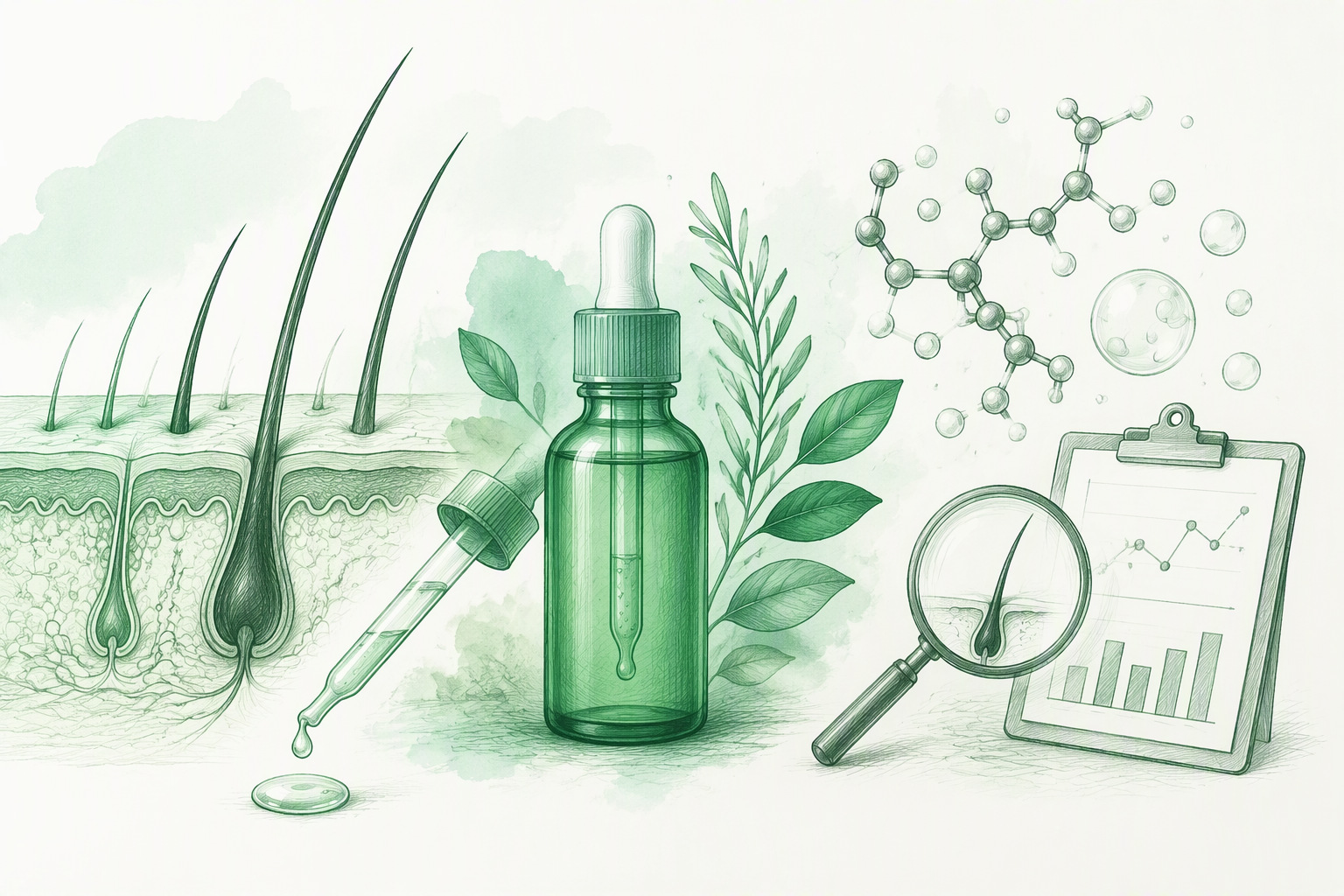
Peptides are short amino-acid chains used for signaling or conditioning purposes. “Peptide” describes a broad ingredient category rather than a standardized treatment.
Some peptides are intended to support the scalp environment, skin condition, or processes associated with follicle function. These mechanisms may warrant study, but laboratory plausibility does not establish visible human regrowth.
Named ingredients such as Copper Tripeptide-1, Biotinoyl Tripeptide-1, and Acetyl Tetrapeptide-3 are easier to assess than an unexplained “peptide complex.” Even then, inclusion in a formula does not prove clinical performance.
Copper Peptides and Biomimetic Peptides
Copper-binding and biomimetic peptides are not identical categories. Copper Tripeptide-1, also known as GHK-Cu, binds copper. Biomimetic peptides are designed to resemble parts of naturally occurring signaling sequences.
Evidence must be assessed ingredient by ingredient. Research on one peptide cannot automatically validate every complete serum that contains it.
Our detailed review of whether copper peptides regrow hair separates human evidence from laboratory findings and mechanism-based claims.
Why Formula Design Matters as Much as the Peptide Name
A peptide formula also needs an appropriate vehicle, compatible ingredients, adequate scalp contact, suitable packaging, and effective preservation. These factors influence stability, tolerability, and practical use.
Third-party microbial or contaminant reports are more informative when brands explain what was tested and provide accessible results. A testing badge without context says little.
More ingredients do not necessarily create a better serum. We prefer focused formulas with a clear rationale and proportionate claims over crowded ingredient lists designed mainly for label appeal.
Minoxidil vs. Non-Drug Peptide Hair Growth Serum
Minoxidil has stronger human evidence for common pattern hair loss than most cosmetic peptide serums. Peptide products should not be described as equivalent unless direct comparative research supports that conclusion.
Key differences include:
- Type and strength of evidence
- Drug or cosmetic status
- Application requirements
- Tolerability and cosmetic feel
- Long-term adherence
- What may happen after treatment stops
Some topical minoxidil products are approved as drugs for specific hair-loss uses. A cosmetic serum should not imply comparable regulatory status.
When Stronger Evidence Does Not Automatically Mean a Better Personal Fit
Diagnosis, tolerance, contraindications, routine compatibility, and willingness to continue all matter. A treatment used inconsistently because it irritates the scalp or disrupts styling may have limited practical value.
Anyone with questions about pregnancy, cardiovascular concerns, medication interactions, or the cause of hair loss should consult a clinician or pharmacist before choosing treatment.
Can Peptide and Minoxidil Products Be Used Together?
Compatibility depends on the formulas, application timing, overall irritation burden, and individual medical circumstances. Adding more products does not guarantee better results.
Starting several leave-on treatments at once also makes it difficult to identify the source of itching, redness, buildup, or changes in shedding. We recommend following medication directions and introducing non-drug products methodically.
Which Hair Serum Ingredients Have Human Evidence?
Ingredients should be compared by evidence quality, not popularity or whether they are natural or synthetic. Minoxidil has stronger clinical support for pattern hair loss than most cosmetic ingredients. Evidence for peptides, caffeine, rosemary, niacinamide, and botanical blends varies and is often less direct.
Natural ingredients are not inherently safer. Essential oils and plant extracts can irritate or trigger allergic reactions, while laboratory-designed ingredients may be more precisely characterized.
Caffeine, Rosemary Oil, and Botanical Complexes
Caffeine and rosemary oil have proposed mechanisms and some human research, but that does not make them equivalent to better-studied drug treatments. Concentration, standardization, study design, vehicle, and irritation risk all require review.
Evidence for one proprietary botanical complex cannot be transferred to a differently formulated product. In our Peptide Hair Serum, we position rosemary oil as a supporting ingredient rather than asking it to carry a regrowth claim by itself.
Niacinamide and Scalp-Support Ingredients
Niacinamide may support the skin barrier, conditioning, and oil management. Those functions can improve comfort and adherence, but they are not the same as demonstrated increases in hair count.
Supportive ingredients still have value. A promising active is unlikely to fit a routine if the complete formula causes irritation, leaves heavy residue, or makes regular application unrealistic.
What Is a Good All-Natural Hair Growth Serum?
“All-natural” is not a reliable standard for efficacy, quality, or safety. We instead assess human evidence, ingredient disclosure, allergen information, preservation, formula stability, and scalp tolerance.
Persistent or progressive loss should not be managed solely according to a preference for natural or synthetic ingredients. The likely cause matters more than the marketing category.
How to Choose the Best Hair Growth Serum for Your Needs
The best hair growth serum is not necessarily the one with the longest ingredient list. We recommend comparing the likely cause of thinning, evidence quality, formula transparency, finish, tolerability, application burden, and ongoing cost.
Oil-heavy products may condition dry hair well, but that does not establish that they address pattern thinning. Match the product to the intended outcome rather than assuming every “growth” serum performs the same job.
Our water-based Peptide Hair Serum uses named peptide and scalp-support ingredients. We present it as cosmetic support, not as a cure or guaranteed substitute for medical treatment.
Hair Growth Serum for Men vs. Women
Many men’s and women’s serums differ mainly in packaging, fragrance, or positioning. Suitability should depend on the cause of thinning, ingredient safety, and supporting evidence.
Pattern loss, postpartum shedding, menopause, medication effects, hormonal changes, and nutritional deficiencies may require different assessments. Medical context matters more than a gendered label.
How to Audit Branded Serums Without Relying on Hype
Whether assessing Minimalist, Thrive, Kilgour, Indulekha, or another brand, ask:
- Does the research test the product or a supplier ingredient?
- Do endpoints measure growth, shedding, or cosmetic fullness?
- Are the full formula and directions disclosed?
- Are adverse effects and limitations discussed?
- Are testimonials replacing controlled evidence?
Ingredient lists can offer clues, but they do not reveal every concentration. Reviews are also less useful when they repeat marketing language or provide no detail about application, timeline, or outcome.
Does Kilgour Hair Serum Work?
The available source material shows that KilgourMD markets a scalp serum for thinning hair and highlights ingredients such as Redensyl®, Capixyl®, Procapil®, saw palmetto, rosemary extract, and ginseng. Those details describe the product; they do not independently prove meaningful regrowth.
We would still look for accessible finished-formula research with clear methods, duration, comparison groups, and objective outcomes. We invite readers to apply that same standard to our formulas.
What Are the Benefits of Indulekha Hair Serum?
Any claimed benefits should be separated into conditioning, scalp care, reduced breakage, reduced shedding, and regrowth. These are different outcomes.
Check whether each claim relies on a finished-formula human study, ingredient research, traditional use, or a proposed mechanism. Conditioning can be worthwhile without proving increased follicle activity.
How to Apply Hair Growth Serum Without Greasy Roots or Buildup
Apply the directed amount to the scalp rather than coating the hair lengths. Using extra serum does not make it work faster.
Fine hair may need smaller, carefully distributed applications to limit residue. Textured hair can be sectioned so the serum reaches the scalp without saturating curls, coils, braids, or protective styles.
A Step-by-Step Scalp Application Method
- Start with dry or damp hair as directed.
- Divide the scalp into narrow sections.
- Apply small amounts along each exposed line.
- Distribute gently with clean fingertips.
- Allow the serum to dry before adding other products when directed.
- Wash hands and avoid unintended transfer.
Consistent scalp placement supports a leave-on routine, but it cannot compensate for an ineffective or poorly supported formula.
How to Reduce Irritation and Product Buildup
Patch test when appropriate and introduce one leave-on product at a time. Avoid casually combining essential oils, exfoliating acids, minoxidil, fragrances, or other potentially irritating treatments.
Cleanse according to scalp needs rather than aggressively scrubbing away residue. Stop use and seek advice for persistent burning, swelling, rash, or inflammation.
Why Shampoo Is Not Usually a Substitute for a Leave-On Serum
A suitable shampoo cleans without causing excessive dryness, irritation, or breakage. Because shampoo is rinsed away, it generally has less scalp contact than a leave-on product.
Longer contact does not itself prove efficacy. We position our Peptide Conditioning Shampoo as a cleansing and scalp-support step, not a guaranteed regrowth treatment.
A leave-in hair treatment for thinning hair must also be judged by what it can realistically accomplish.
Hair Growth Serum Results: Timeline, Tracking, and Side Effects
Credible evaluation separates tolerability, shedding, short hairs, and visible density. Changes related to the hair cycle generally require sustained observation rather than a few days of use.
Rapid improvements are more likely to reflect coating, styling, moisture, or root lift than altered follicle activity. Possible side effects vary but may include itching, redness, irritation, buildup, greasy roots, or unwanted transfer.
What Progress May Look Like Over Time
First assess scalp comfort, residue, adherence, and routine fit. Over time, monitor shedding and short hairs while remembering that breakage can resemble regrowth.
Later comparisons should focus on part width, density, and scalp visibility. We recommend setting expectations from the product’s actual evidence rather than assuming every cosmetic peptide serum follows the same timeline.
A Standardized At-Home Tracking Protocol
Take baseline and follow-up photographs using the same:
- Camera and lens
- Room and lighting
- Distance and angle
- Dry-hair state
- Part location
- Styling routine
Record adherence, wash schedule, illness, unusual stress, medication changes, and scalp reactions. Treat shower-hair counts cautiously because washing frequency and handling can affect them.
What Happens If You Stop?
The outcome depends on the product, underlying condition, and whether continued treatment is needed to maintain any effect. Brands should not promise permanent results without long-term evidence.
If shedding returns or worsens, seek a clinician-guided plan rather than repeatedly switching cosmetic products without reviewing the diagnosis.
When Hair Loss Needs a Clinician, Not Another Serum
A serum cannot diagnose thinning. Possible causes include pattern hair loss, stress-related shedding, postpartum changes, nutritional deficiency, medication effects, inflammatory scalp disease, and autoimmune conditions.
Persistent or unexplained loss deserves assessment by a dermatologist or another qualified healthcare professional. Identifying the cause can prevent wasted time and guide a more suitable treatment choice.
Warning Signs That Merit Prompt Evaluation
Seek evaluation for:
- Sudden or clump-like shedding
- Rapidly widening or smooth patches
- Scalp pain, pustules, scaling, or intense itching
- Inflammation or possible scarring
- Eyebrow or eyelash loss
- Other unexplained physical symptoms
- Loss following an illness or new medication
- Continued progression despite consistent treatment
These signs call for assessment, not another blind cosmetic purchase.
What to Bring to a Hair-Loss Appointment
Bring a timeline, standardized photographs, family history, medication and supplement list, recent illnesses, dietary changes, and products used. Mention pregnancy, postpartum status, menstrual changes, menopause, or other relevant hormonal changes.
Ask about the likely diagnosis, whether testing is appropriate, realistic outcomes, treatment duration, and maintenance.
Evidence-First Purchase Checklist
Before buying, confirm:
- The precise promised outcome
- Whether evidence covers the formula or selected ingredients
- The dose and application burden
- The evaluation period
- Safety and adverse-effect information
- Total cost
- Likely maintenance requirements
- Whether the routine is sustainable
Choose transparent evidence over testimonials, vague complexes, gendered packaging, or borrowed authority.
FAQ
What Is a Good All-Natural Hair Growth Serum?
“All-natural” does not establish efficacy or gentleness. Look instead for relevant evidence, disclosed ingredients, appropriate preservation, allergen information, and a tolerable application method. Botanical extracts and essential oils can still irritate.
Does Kilgour Hair Serum Work?
Its product page identifies several branded complexes and botanical ingredients, but those inclusions alone do not prove that the finished serum produces regrowth. Look for accessible human research on the marketed formula, with clear methods and objective endpoints.
What Is the Best Shampoo for Hair Fall and Hair Growth?
We recommend a shampoo that suits the scalp and cleans without causing excessive dryness, irritation, or breakage. Shampoo may support scalp comfort, but persistent shedding or pattern thinning usually requires assessment beyond changing cleansers.
What Are the Benefits of Using Indulekha Hair Serum?
Potential benefits should be divided into conditioning, scalp comfort, reduced breakage, shedding reduction, and regrowth. Softer or fuller-looking hair should not automatically be interpreted as increased density.
Is a Peptide Serum as Effective as Minoxidil?
Current evidence does not establish cosmetic peptide serums as equivalent to minoxidil for common pattern hair loss. Peptide products may provide non-drug cosmetic support, but claims should remain proportionate to the evidence.
Choose a Hair Growth Serum Based on Evidence
Review the formula, supporting evidence, tolerability, application burden, and realistic timeline before committing to a serum. Explore our peptide-focused options at rootsbyga.shop for a transparent, evidence-not-hype approach to scalp and hair care.


