
Posted by rootsbyga.shop
on October 18, 2026

TL;DR
A peptide shampoo may support cleansing, scalp comfort, manageability, reduced breakage, and temporary fullness. However, peptides in a rinse-off formula do not automatically reach follicles or produce new hair growth. We recommend assessing the complete formula, intended benefit, delivery rationale, and finished-product evidence—not the peptide name alone.
Table of Contents
- Peptide Shampoo: What It Can—and Cannot—Do for Thinning Hair
- What Are Peptides, and How Do They Differ From Proteins and Amino Acids?
- Do Peptides in Shampoo Reach the Hair Follicle?
- Which Hair-Care Peptides Have Evidence?
- How to Choose the Best Peptide Shampoo: An Evidence-First Checklist
- Peptide Shampoo vs. Conditioner, Serum, and Hair-Loss Treatments
- How to Use Peptide Shampoo and Measure Results
- Is Peptide Shampoo Suitable for Your Hair and Scalp Type?
- Peptide Shampoo FAQs—and When Hair Thinning Needs Medical Assessment
- FAQ
- Choose Evidence Over Shampoo Hype
Peptide Shampoo: What It Can—and Cannot—Do for Thinning Hair

A peptide shampoo can cleanse the scalp, condition hair, and sometimes make strands look fuller. Yet “contains peptides” is not proof that a shampoo stimulates follicles or creates new growth.
We separate four commonly blurred outcomes:
- Temporary fullness: Hair looks thicker because of cleansing or coating.
- Reduced breakage: Fewer strands snap during washing or styling.
- Reduced shedding: Fewer complete hairs are released from the scalp.
- New growth: Follicles produce more or thicker hair over time.
These outcomes require different evidence. Fewer broken hairs may show improved retention, but they do not demonstrate follicular growth. Our standard at rootsbyga.shop is to assess the formula, claimed outcome, delivery method, and relevant testing.
Hair-Shaft Improvement Is Not Follicle Stimulation
The visible hair shaft is nonliving fiber, while growth occurs within the follicle. Conditioning agents, proteins, and film formers can reduce friction or improve the appearance of existing strands without changing follicular activity.
What Shampoo Can Reasonably Contribute
A suitable shampoo can remove oil and buildup, support scalp comfort, and limit friction during washing. Those effects may help people retain fragile hair.
Claims involving density, shedding, or growth need evidence from the finished rinse-off product. Our evidence-first guide to shampoo for thinning hair explains why cleansing support is not the same as hair-loss treatment.
What Are Peptides, and How Do They Differ From Proteins and Amino Acids?
Amino acids are molecular building blocks. Peptides are chains of amino acids, while proteins are larger structures with more complex folding. Size, sequence, charge, solubility, and formulation can influence how these ingredients behave.
Hydrolyzed proteins are often used for film formation and conditioning. That may help damaged hair feel smoother, but it does not establish activity within the follicle. See what a peptide is and how peptide structure affects function for more detail.
Peptides Versus Hydrolyzed Proteins
A label may identify a specific peptide or list hydrolyzed wheat, rice, silk, keratin, or another protein mixture. A precise technical name improves transparency but does not reveal an effective concentration or prove a result.
Are Amino Acid Shampoos Good for Hair?
They can be, although performance depends on the full cleansing and conditioning system. “Amino acid” does not guarantee mildness or scalp compatibility. We recommend choosing according to oil levels, dryness, chemical processing, and sensitivity.
Do Peptides in Shampoo Reach the Hair Follicle?
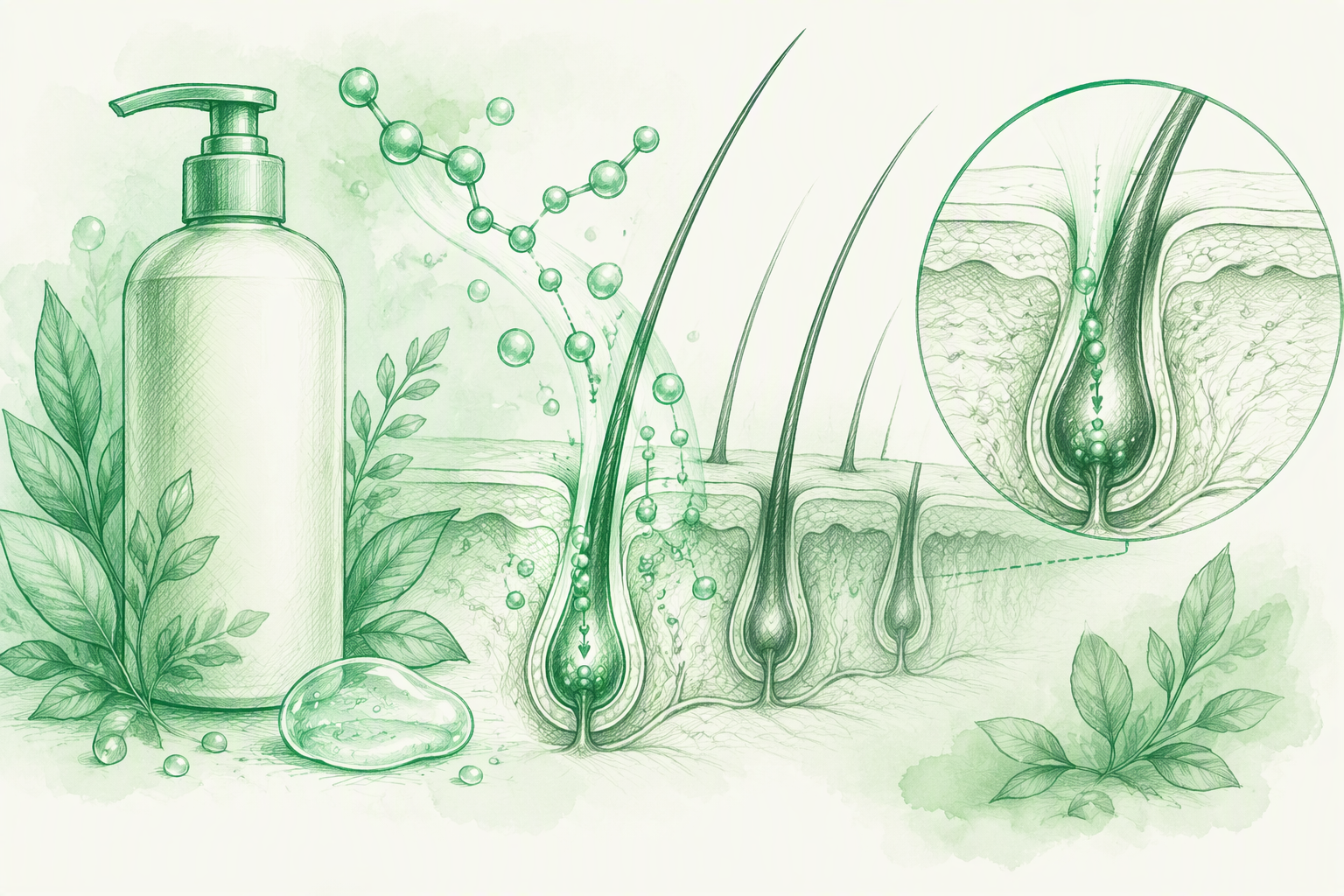
Follicular delivery cannot be inferred from an ingredient list. Shampoo has limited contact before rinsing, while deposition depends on the peptide, vehicle, scalp condition, and formulation technology.
We distinguish between laboratory rationale, research on an isolated ingredient, and human testing of the marketed shampoo. Only the last directly evaluates normal use of the finished product.
Why Rinse-Off Contact Time Matters
Shampoo is primarily designed to cleanse. Brief contact does not make peptides useless, particularly when they are intended to condition the hair shaft, but it makes product-specific evidence essential for follicular claims.
Why Leaving Peptide Shampoo on Longer Is Not Automatically Better
Longer exposure may increase dryness or irritation without improving peptide delivery. We recommend following the tested directions rather than treating shampoo as a leave-on mask.
Ingredient Evidence Versus Finished-Formula Evidence
The strongest evidence matches the marketed product’s format, directions, target users, and claimed outcome. Research on a raw ingredient or leave-on serum cannot confirm that the same ingredient works in shampoo.
Which Hair-Care Peptides Have Evidence?
Copper-binding, biomimetic, signal, and hair-binding peptides are marketed for different purposes. We do not treat them as interchangeable.
When reviewing research, we consider study design, controls, duration, measurement methods, and potential funding conflicts. A plausible mechanism is useful, but it is not a finished-product verdict.
Copper Peptides
Copper peptides are discussed for potential signaling and scalp-related roles, but evidence varies by peptide and formulation. Research on a raw material or leave-on product cannot automatically validate copper peptide shampoo. Our guide to whether copper peptides can regrow hair examines that distinction.
Biomimetic and Signal Peptides
Biomimetic peptides are designed to imitate selected biological sequences or signals. The term describes the design, not guaranteed efficacy. We look for the exact peptide, formulation context, and relevant human evidence.
Hair-Binding and Fiber-Conditioning Peptides
Some peptides are intended to associate with damaged fibers. They may improve feel, detangling, or resistance to mechanical breakage. Hair-shaft affinity does not demonstrate delivery to the follicle.
How to Choose the Best Peptide Shampoo: An Evidence-First Checklist
The best peptide shampoo is the one that suits its stated purpose and supports its claims. We assess peptide identification, formulation rationale, finished-product testing, tolerability, and transparent directions.
Questions to Ask Before Buying
Ask:
- Which peptide or peptide complex is used?
- Is there a delivery rationale suited to shampoo?
- Was the finished formula tested?
- Did testing measure breakage, shedding, density, or cosmetic volume?
- Do the claims match the measured outcome?
- Are the directions and tolerability information clear?
How to Read the Ingredient List Without Overinterpreting It
Ingredient order can provide broad concentration clues, but it cannot confirm an effective dose. Review the entire formula, including surfactants, fragrance, conditioning polymers, oils, film formers, preservatives, and personal irritants.
A peptide near the end is not automatically ineffective. Equally, a prominent technical name does not prove potency.
Red Flags in Peptide Shampoo Reviews and Marketing
We are cautious of uncontrolled photographs, vague “clinically proven” language, missing measurement methods, and ingredient studies presented as product studies. Reviews can describe lather, scent, softness, and volume, but they cannot establish increased follicular density.
Peptide Shampoo vs. Conditioner, Serum, and Hair-Loss Treatments
Shampoo prioritizes cleansing, conditioner targets the shaft, and serum provides longer contact. Conditioner may therefore be more logical for detangling and breakage, while a scalp serum may offer more exposure to leave-on ingredients. Neither format guarantees growth.
Peptide shampoo should not replace diagnosis, minoxidil, or prescribed treatment.
Using Peptide Shampoo Alongside Minoxidil
Use both products according to their labels or clinical guidance. Shampoo and rinse first, allow the scalp to dry, and then apply minoxidil if its directions specify a dry scalp. Do not mix minoxidil into shampoo.
Can Peptide Shampoo Interfere With Prescription Treatment?
Compatibility depends on the complete formula. Irritation or residue may make a treatment routine harder to maintain even without a known direct interaction. We recommend discussing persistent reactions with a clinician or pharmacist.
When Conditioner or a Leave-On Format May Be More Logical
Choose conditioner when the priority is lower friction, easier detangling, or improved feel. Consider a leave-on product when prolonged contact is appropriate and supported by its directions and evidence.
How to Use Peptide Shampoo and Measure Results
Follow the label and adjust wash frequency to oil, buildup, texture, styling habits, and scalp condition. Separate immediate cosmetic changes from longer-term trends.
A Realistic Results Timeline
Softness, cleansing, tangling, volume, and irritation can be judged early. Breakage and shedding patterns require consistent observation over time, while density changes need standardized records rather than isolated photographs.
How to Track Breakage, Shedding, and Density
Take photographs under consistent lighting, angle, part placement, and hair condition. Record wash frequency, broken hairs, shedding, itching, redness, and flaking. Where practical, change one major routine variable at a time.
When to Stop Using It
Stop using the shampoo if it causes persistent burning, redness, swelling, rash, or worsening flaking. Seek urgent care for breathing difficulty, facial swelling, or other signs of a serious allergic reaction.
Is Peptide Shampoo Suitable for Your Hair and Scalp Type?
Suitability depends mainly on the full cleansing and conditioning system. The peptide alone cannot tell us whether a formula will suit dry, oily, processed, or sensitive hair.
Color-Treated or Chemically Processed Hair
Prioritize gentle cleansing, low friction, and adequate conditioning. A peptide claim does not compensate for a formula that leaves processed hair rough or tangled.
Dry, Fragile, or Breakage-Prone Hair
Consider wash frequency, heat exposure, detangling, and conditioner use. Reducing breakage can improve retained length and apparent fullness, but it does not create new follicles.
Oily or Buildup-Prone Scalp
The shampoo must remove enough oil and residue for the required wash schedule. Cleansing performance and peptide evidence should be assessed separately.
Sensitive or Reactive Scalp
Review fragrance and known triggers, then introduce the product cautiously. Persistent itching, pain, redness, or scaling needs medical assessment.
Peptide Shampoo FAQs—and When Hair Thinning Needs Medical Assessment
Does Peptide Shampoo Grow Hair?
Peptide inclusion alone does not prove growth. The finished formula needs relevant human evidence showing a follicular outcome under normal rinse-off conditions.
Is Plum Peptide Shampoo Good for Hair?
We would assess the exact formula, cleansing system, peptide disclosure, directions, and product testing. General reviews cannot establish reduced shedding or increased density.
How Should I Assess K18 Peptide or OGX Peptide Shampoo Claims?
Apply the same criteria to every brand: product format, peptide identity, contact time, tested outcome, and finished-formula evidence. K18, for example, offers shampoos positioned around detoxification, protection, and damage care; that positioning does not itself prove follicular growth.
Which Shampoo Is Rich in Protein?
Look for hydrolyzed keratin, wheat, rice, soy, silk, or similar proteins. Without concentration disclosure, however, a label cannot confirm that a shampoo is “rich” in protein.
When Should Thinning Hair Be Assessed by a Clinician?
Seek assessment for sudden or severe shedding, smooth bald patches, scarring, scalp pain, marked inflammation, eyebrow loss, or thinning accompanied by other symptoms. Shampoo cannot diagnose the cause.
FAQ
How Do Peptides Help Hair?
Some peptides may condition damaged fibers or reduce breakage. Others are studied for biological signaling. Their effects depend on their structure, formulation, and supporting evidence.
Can Peptide Shampoo Make Hair Look Thicker?
It may create temporary fullness through cleansing, conditioning, or coating effects. That visible change should not be confused with new growth.
Is Amino Acid Shampoo Good for Hair?
It can be when the overall formula suits the hair and scalp. Surfactants, fragrance, conditioning ingredients, and wash frequency often matter more than the label alone.
Can I Use Peptide Shampoo With Minoxidil?
They may fit into separate steps of a routine. Rinse the shampoo fully, let the scalp dry, and use minoxidil according to its label or clinician guidance.
How Can I Tell Whether a Peptide Shampoo Works?
Define the intended outcome first, then track it consistently. Softness, breakage, shedding, and density are different endpoints and should not be treated as interchangeable.
Choose Evidence Over Shampoo Hype
Choose peptide shampoo by what the finished formula can support—not by its price, technical language, or before-and-after photographs. Explore rootsbyga.shop for science-led peptide hair care grounded in transparent reasoning, realistic expectations, and evidence.


