
Posted by rootsbyga.shop
on October 20, 2026

TL;DR
Copper peptide hair growth is plausible, but strong controlled human evidence for meaningful regrowth remains limited. Copper peptide products may support scalp comfort or the appearance of existing hair, but they should not be treated as proven replacements for established care. We recommend judging each formula by transparent ingredients, relevant testing, tolerability, and measured results—not marketing language.
Table of Contents
- Copper Peptide Hair Growth: The Evidence-Based Answer
- What Are Copper Peptides, GHK-Cu and Copper Tripeptide-1?
- How GHK-Cu Might Affect the Scalp and Hair Follicle
- What the Research Actually Shows
- Who Might Benefit—and Why the Cause of Hair Loss Matters
- Copper Peptides vs Minoxidil, Finasteride and Other Hair-Loss Options
- How Long Do Copper Peptides Take to Work?
- How to Choose a Copper Peptide Hair Product Without Falling for Hype
- Downsides, Side Effects and Combining Copper Peptides With Other Treatments
- Bottom Line: Promising Adjunct, Not Proven Hair-Regrowth Replacement
- FAQ
- Choose Evidence Over Hype
Copper Peptide Hair Growth: The Evidence-Based Answer

Copper peptides are widely promoted in hair-growth products. Convincing evidence of consistent human hair regrowth is harder to find.
Our verdict is measured: copper peptides have plausible biological activity, but that does not establish visible, clinically meaningful regrowth. A calmer scalp, softer hair, reduced breakage, or fuller-looking strands can all be useful outcomes. None proves that a product created new terminal hairs.
We view copper peptides as a possible supporting ingredient rather than a substitute for diagnosis-specific care. Anyone evaluating a serum should separate cosmetic improvement from changes in hair count, density, and shaft diameter. Our guide to what counts as real roots hair growth explains how to make that distinction.
What Would Count as Proof of Hair Regrowth?
Useful evidence may include:
- Hair counts within a defined scalp area
- Density or shaft-diameter measurements
- Standardized photographs taken under consistent conditions
- Controlled comparisons against a placebo or established treatment
Testimonials and before-and-after photographs may describe an individual experience, but they cannot rule out changes in lighting, styling, hair length, concurrent treatments, or natural fluctuation.
What Are Copper Peptides, GHK-Cu and Copper Tripeptide-1?
Copper is a chemical element with the symbol Cu and atomic number 29. In cosmetic products, copper may be incorporated into a peptide complex rather than used as copper metal.
GHK-Cu is the name commonly used for a copper-binding peptide complex. Cosmetic labels may identify a related ingredient as Copper Tripeptide-1. Shoppers should still confirm the precise ingredient and formulation with the manufacturer rather than assuming every “copper peptide complex” is identical.
The ingredient name alone does not reveal its concentration, purity, stability, or ability to reach the intended scalp tissue. Copper peptides are also not equivalent to dietary copper supplements; the forms, exposure routes, and intended uses differ.
Why Ingredient-List Wording Matters
“Copper Tripeptide-1” gives us more information than a vague proprietary peptide blend. It still does not prove effective delivery or finished-product performance.
Claims such as “advanced peptide technology” or “clinically inspired” are marketing descriptions unless they are supported by accessible, relevant testing.
How GHK-Cu Might Affect the Scalp and Hair Follicle
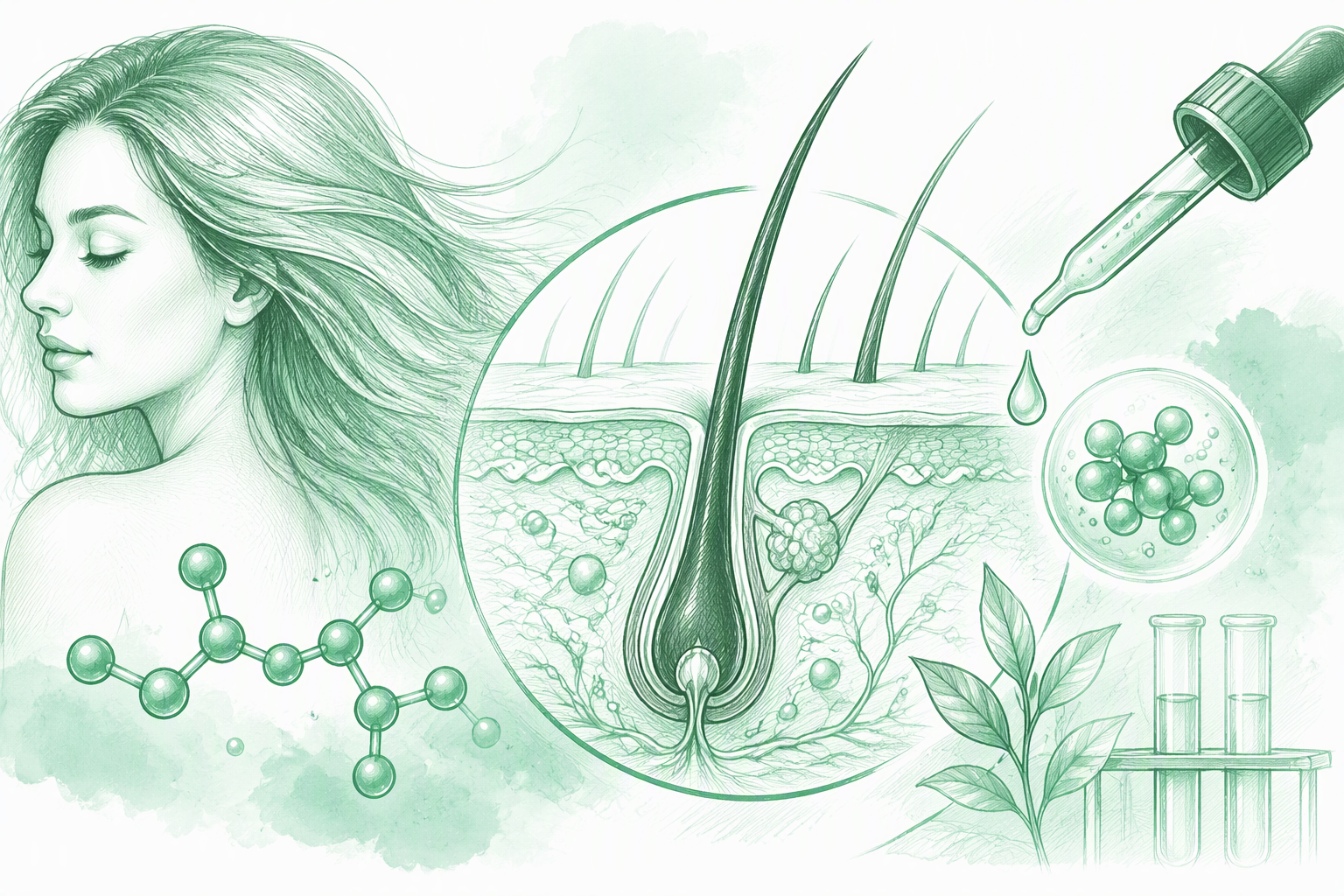
Copper peptides are often discussed in relation to tissue condition, repair processes, and the environment surrounding the follicle. These proposed actions offer a reason to study them, not proof that a topical formula reverses thinning.
Laboratory observations are especially limited when applied to real-world products. A response in isolated cells does not show that an intact peptide reaches the necessary part of a human follicle after topical application.
Why a Plausible Mechanism Is Not Clinical Proof
Performance can be affected by the product vehicle, ingredient stability, concentration, contact time, scalp condition, and application consistency. The cause of hair loss also matters.
A formula may improve scalp comfort without reversing pattern-related miniaturization, autoimmune hair loss, or follicle damage. Mechanism-focused marketing often overlooks that difference.
What the Research Actually Shows
Research should be assessed by evidence level. Cell, animal, and ex vivo follicle studies can identify signals worth investigating, but they do not directly establish increased human hair density.
For human research, we look for a suitable control, clearly identified ingredients, sufficient follow-up, objective endpoints, and testing of the finished formula being sold. Results from a multi-ingredient serum cannot show which ingredient caused the outcome or validate every other product containing a similar peptide.
The main limitation is the lack of a large, consistent body of controlled human evidence showing that standalone topical copper peptides produce meaningful regrowth. Anyone considering a hair growth serum should look for evidence, not hype.
A Practical Evidence Hierarchy
From most to least directly relevant:
- Controlled human scalp trials using a comparable formulation
- Other human studies with objective measurements
- Finished-formula studies without a suitable control
- Ex vivo follicle and animal research
- Cell experiments, surveys, testimonials, and brand photographs
These forms of evidence answer different questions and should not be treated as interchangeable.
Red Flags in “Clinically Proven” Claims
We recommend caution when a claim relies on:
- No accessible study
- No comparison or control group
- Undisclosed endpoints
- Consumer opinion alone
- Inconsistent photography
- Research on a different formula
- Softness or scalp appearance presented as regrowth
“Dermatologist tested” does not, by itself, mean that a product increased hair count.
Who Might Benefit—and Why the Cause of Hair Loss Matters
“Thinning hair” can refer to progressive miniaturization, temporary shedding, breakage, traction, inflammation, autoimmune conditions, or scarring. No single cosmetic ingredient should be expected to address every cause.
A copper peptide product may suit someone seeking a supportive scalp-care step who accepts the uncertainty around regrowth. It is less appropriate as a reason to delay assessment when hair loss is rapid, persistent, painful, patchy, or accompanied by substantial scalp changes.
Signs That Point to Different Problems
Patterns worth discussing with a qualified clinician include:
- Gradual temple, crown, or part-line thinning
- Sudden diffuse shedding
- Smooth, distinct bald patches
- Short broken hairs rather than hairs shed from the root
- Pain, marked scaling, inflammation, pustules, or possible scarring
A clinician can consider the pattern, timeline, family history, medications, scalp condition, and possible systemic contributors.
Copper Peptides vs Minoxidil, Finasteride and Other Hair-Loss Options
Minoxidil has a more established clinical evidence base for certain forms of hair loss than topical copper peptides. Finasteride is a prescription treatment used in appropriate patients, but its suitability and risks require clinical discussion.
Copper peptides occupy a different category. We position them as a possible complement to a broader regimen, not as evidence-equivalent replacements for established treatments.
A well-tolerated shampoo or leave-on serum may help make scalp care more manageable. That supportive role should not be confused with treating the underlying cause of progressive loss.
Can Copper Peptides Replace Minoxidil?
Current evidence does not justify treating copper peptides as a one-for-one minoxidil replacement. Their proposed actions and level of human evidence differ.
People who cannot tolerate or do not want minoxidil should discuss alternatives with a qualified clinician rather than assuming that a cosmetic peptide serum offers equivalent results.
How Long Do Copper Peptides Take to Work?
There is no reliable universal timeline for copper peptide hair growth. Products vary, and the available evidence does not support promises tied to a specific week.
Scalp comfort or hair feel may change before density. Reduced breakage, reduced shedding, and new growth are also separate outcomes. We recommend scheduled assessments rather than daily mirror checks.
How to Take Standardized Progress Photos
Keep these factors consistent:
- Camera, lighting, distance, and angle
- Hairstyle, hair length, and part placement
- Wet or dry hair
- Product use immediately before photography
Capture the same hairline, temples, part, and crown at each checkpoint.
What to Track Besides Photos
Record adherence, irritation, scalp symptoms, other treatments, illness, major stress, and chemical processing. Our review of multi-peptide serum evidence and results offers a broader framework for assessing formula benefits.
How to Choose a Copper Peptide Hair Product Without Falling for Hype
No product can be called universally best without transparent comparative evidence. We suggest prioritizing complete ingredient lists, clear scalp-use directions, appropriate packaging, and testing that relates to the finished formula.
A larger concentration claim does not necessarily mean better delivery, tolerability, or results. At rootsbyga.shop, we favour precise ingredient language and measurable monitoring over “breakthrough” promises.
Five Questions to Ask Before Buying
- Is the copper peptide specifically identified?
- Is the evidence relevant to the finished formula?
- Is the product intended for scalp application?
- Are the directions and packaging clear?
- Were hair count or density measured?
Claims That Deserve Scrutiny
Question claims such as “reactivates dormant follicles,” “clinically inspired,” or “proven” when no relevant study is available. Before-and-after photographs also require consistent lighting, styling, hair length, and part placement.
Downsides, Side Effects and Combining Copper Peptides With Other Treatments
Any topical formula may cause redness, itching, dryness, or stinging. The cause could be the peptide or another ingredient, including fragrance, preservatives, solvents, or botanical extracts.
Follow the product directions and stop use if significant or persistent irritation develops. When combining products, introduce one change at a time so that reactions are easier to identify.
We do not recommend applying a cosmetic serum immediately after microneedling unless its instructions and a qualified professional support that use. A disrupted skin barrier may change exposure and irritation risk.
Can Copper Peptides Cause Shedding?
Copper peptides do not have a clearly established universal “purging” phase. New or worsening shedding should not automatically be interpreted as proof that a product is working.
When to Ask a Dermatologist
Seek professional assessment for rapid loss, bald patches, scalp pain, substantial inflammation, possible scarring, persistent unexplained shedding, or hair loss accompanied by other symptoms.
Bottom Line: Promising Adjunct, Not Proven Hair-Regrowth Replacement
Copper peptides may support scalp care or the condition of existing hair, but those benefits are not equivalent to confirmed regrowth.
Our approach is straightforward: identify the likely cause, choose a transparent formula, monitor tolerability, document results consistently, and do not postpone better-supported care. Confidence should follow the evidence, not the marketing.
FAQ
Do Copper Peptides Increase Hair Growth?
They may have biological activity relevant to the scalp, but controlled human evidence is not strong enough to promise meaningful regrowth.
What Are the Main Downsides?
The main concerns are uncertain efficacy, inconsistent formulations, possible irritation, and delayed diagnosis or treatment.
How Long Do Copper Peptides Take to Work?
No evidence-based universal deadline exists. Track scalp condition, shedding, photographs, and other treatments at scheduled intervals.
Which Copper Peptide Is Best for Hair Growth?
There is no proven universal winner. Look for a clearly identified ingredient, transparent formula, suitable directions, good tolerability, and relevant finished-product testing.
Choose Evidence Over Hype
Explore our science-led hair and scalp formulations at rootsbyga.shop, and build a regimen around transparent ingredients, measurable results, and appropriate professional care.


