
Posted by rootsbyga.shop
on October 16, 2026

TL;DR
A hair follicle is the living structure beneath the skin that produces hair. The visible strand is a nonliving, keratinized fiber. A white tip on a shed hair is usually a club root, not the whole follicle. Resting or miniaturized follicles may still produce hair, but follicles destroyed by scarring cannot be revived by cosmetic products. Effective care starts with identifying the cause of thinning.
Table of Contents
- What Is a Hair Follicle?
- Hair Follicle Anatomy
- The Hair Growth Cycle
- Did You Pull Out the Hair Follicle?
- Dormant, Miniaturized, Scarred, or Dead Hair Follicles?
- How Many Hairs Grow From One Follicle?
- Hair Follicle Problems
- Hair Follicle Treatments and Peptides
- How to Track Hair and Scalp Changes
- FAQ
- Choose Follicle Care Based on Evidence
What Is a Hair Follicle?
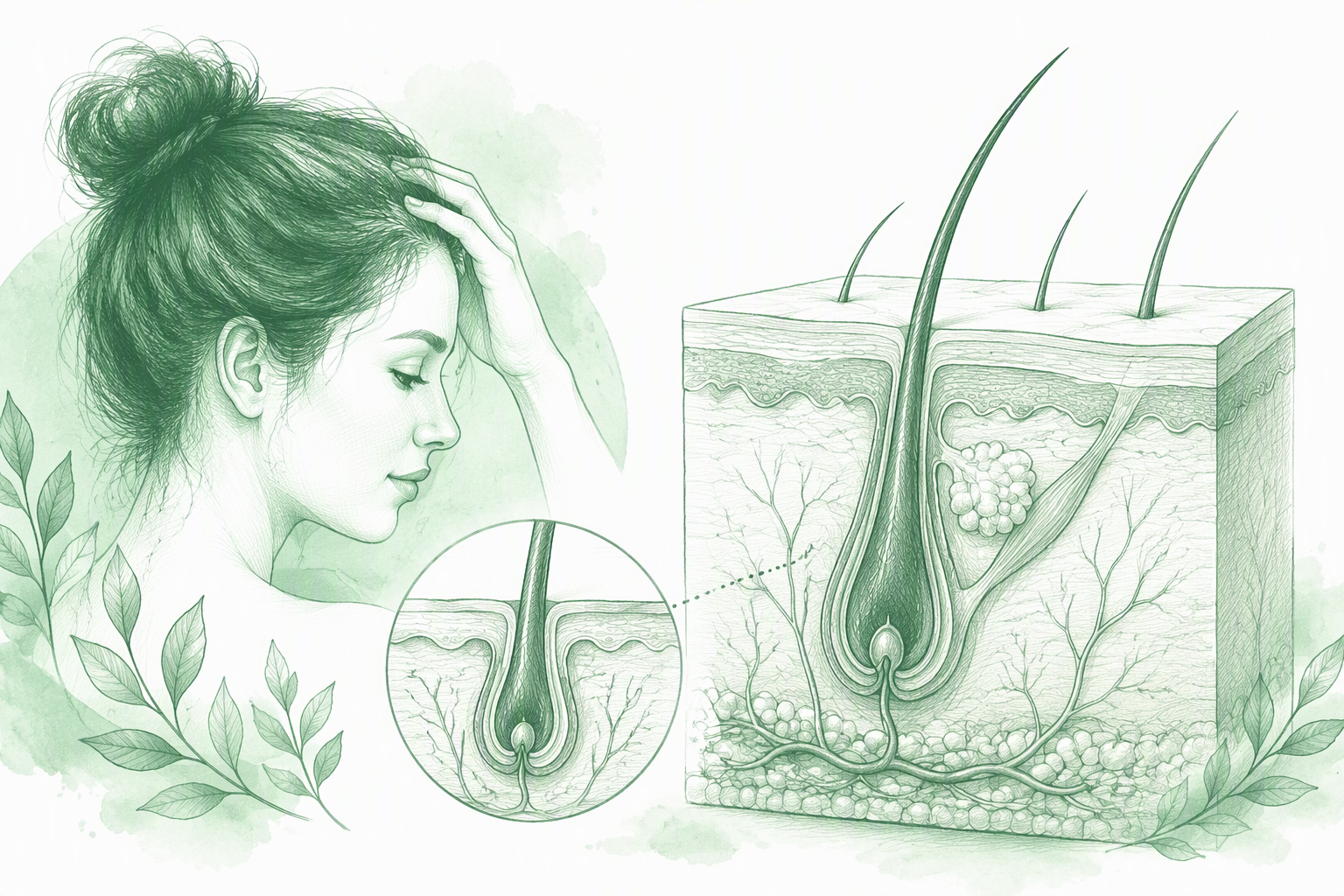
A hair follicle is a living, tube-like structure in the skin that anchors a hair and controls its production and growth cycle. It responds to biological signals, including hormones, and connects with structures such as the sebaceous gland.
The visible hair shaft is different. It consists mainly of keratinized cells and has no living blood supply. The follicle remains beneath the skin.
Hair vs. hair follicle: the simplest distinction
Hair is the fiber produced by a follicle. The hair is the product; the follicle is the structure that makes it.
That distinction explains why cutting hair does not change its biological growth rate. Conditioners, masks, oils, and bond treatments can improve the shaft’s appearance or feel, but that is not the same as changing follicle activity, shedding, or growth cycles.
We encourage customers to separate shaft care from scalp care. Both can be useful, but they serve different purposes.
What is the role of the hair follicle?
The follicle produces and anchors hair while regulating periods of growth, transition, rest, and release. It also interacts with oil glands, nerves, immune activity, connective tissue, and surrounding skin.
For that reason, “stimulates follicles” is too vague to establish that a treatment works. A credible claim should explain what was tested and which outcome changed.
Hair Follicle Anatomy
The upper follicle opens onto the skin surface. Its lower portion extends into the skin and, during active growth, forms the bulb. Matrix cells within the bulb develop into the hair shaft and its supporting inner sheath.
The follicle is also associated with the sebaceous gland, root sheaths and arrector pili muscle. Blood vessels support living tissue around the follicle but do not run through the visible strand.
The bulb, matrix, and dermal papilla
Hair production takes place around the bulb during the active growth phase. Matrix cells divide and mature into the keratinized material that eventually emerges from the scalp.
At the base, the dermal papilla helps support follicular signalling. This does not mean every scalp ingredient reaches that target or changes its activity. Evidence must account for the particular ingredient, formulation and method of delivery.
Sebaceous gland, follicular opening, and surrounding skin
The sebaceous gland releases sebum into the follicular canal. Sebum contributes to the skin and hair environment, although excess oil, irritation and product buildup can cause scalp concerns.
An oily or flaky scalp does not automatically indicate follicle damage. Gentle cleansing may help, but persistent pain, pustules, scale or hair loss deserves professional assessment rather than aggressive “detoxing.”
The Hair Growth Cycle
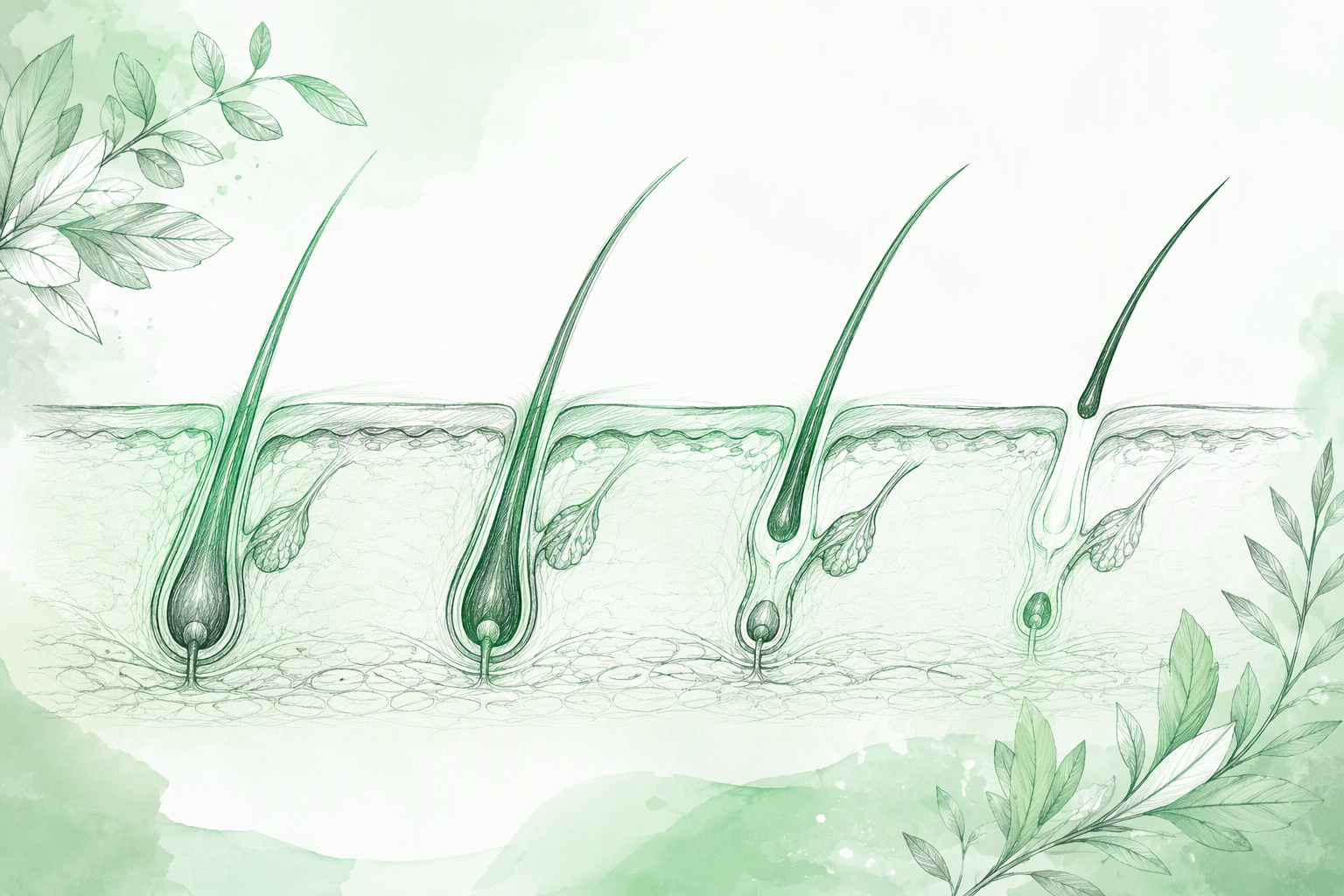
Hair follicles pass through four commonly described phases:
- Anagen: Active hair production
- Catagen: Transition away from active growth
- Telogen: Rest
- Exogen: Release of the existing hair
Scalp follicles do not all cycle together. Growth, rest and shedding can therefore happen at the same time. Density depends partly on how many follicles are active and the thickness of the hairs they produce.
Why normal shedding does not mean follicle loss
Exogen releases the hair fiber, not necessarily the follicle. The follicle usually remains in the skin and may produce another hair.
One day’s collection of shed hairs cannot diagnose a condition. Pattern, duration, changes in shaft thickness, scalp symptoms and recent health events provide more useful context.
How stress, illness, and major changes affect hair
Illness, emotional stress, hormonal changes, restricted diets, weight loss and some medications can disrupt normal cycling. The resulting shedding may appear after the original trigger, making the connection difficult to recognize.
A topical product cannot instantly reverse a cycle change already underway. Recovery may occur once the trigger has passed, but persistent, severe or unexplained shedding should be medically evaluated.
Did You Pull Out the Hair Follicle?
A shed or plucked hair usually does not contain the entire follicle. The follicle is living tissue embedded in the skin. The pale tip on a naturally shed hair is commonly a hardened club root.
Club root, hair root, and follicle are not interchangeable terms
- Hair shaft: The visible keratinized fiber
- Club root: The hard end of a naturally released hair
- Hair root: The portion below the skin before release
- Hair follicle: The living structure that produces the hair
Calling any attached white material “the follicle” is anatomically inaccurate.
Can a plucked hair grow back?
A plucked hair can often grow back if the follicle remains intact. A white-tipped hair alone is not evidence of permanent loss.
Repeated plucking, traction, inflammation or injury can damage the area and may eventually cause scarring. We do not recommend testing regrowth by repeatedly pulling hairs.
Dormant, Miniaturized, Scarred, or Dead Hair Follicles?
“Dead follicle” is usually a marketing phrase rather than a precise diagnosis. A follicle may be resting, inflamed, miniaturized, scarred or destroyed. Each state has a different outlook.
For more context, see our guide to what causes hair thinning.
Miniaturization and androgen sensitivity
In androgenetic hair loss, susceptible follicles respond to androgen signalling by producing progressively finer, shorter hairs. This often follows a pattern, but not every form of thinning is androgen-related.
Hair may be terminal, miniaturized or vellus-like. Standardized photographs can reveal gradual changes more reliably than memory.
When hair follicle regrowth may be possible
Prospects may be better when follicles remain present but are cycling abnormally or producing finer hairs. Improved coverage does not always require new follicles; it may come from reduced shedding or thicker existing hairs.
Results depend on the cause, duration, follicle condition and treatment used. No cosmetic formula can guarantee regrowth.
When hair loss may be permanent
Scarring alopecias can destroy follicular structures. Smooth areas with missing follicular openings, pain, burning, crusting, pustules or rapidly expanding loss should be assessed by a dermatologist.
Once a follicle has been destroyed and replaced by scar tissue, a cosmetic serum cannot restore it.
How Many Hairs Grow From One Follicle?
A single follicle generally produces one shaft at a time. Several follicles can, however, form a follicular unit and appear to emerge together. The cited dermatology commentary describes follicular units containing multiple follicles.
Follicle vs. follicular unit
A follicular unit is a close group of separate follicles. What appears to be several hairs from one pore may therefore be neighbouring follicles rather than multiple shafts from one follicle.
Coverage also depends on shaft thickness, color contrast, length and the proportion of hairs actively growing.
When multiple hairs or bumps need assessment
Grouped hairs without symptoms are often normal. Tender bumps, redness, discharge or recurring ingrown hairs can indicate inflammation.
We recommend avoiding squeezing, digging or repeated plucking. Manipulation can worsen irritation and complicate assessment.
Hair Follicle Problems
Folliculitis is inflammation of one or more follicles. It can have infectious or noninfectious causes. Ingrown hairs develop when a hair curves into or grows beneath the skin, often after hair removal.
Neither condition should be confused with routine shedding or gradual miniaturization.
Signs of an inflamed or infected hair follicle
Possible signs include tenderness, itching, redness, pustules and crusting. Spreading redness, drainage, fever or rapidly worsening pain requires prompt medical advice.
Friction, shaving, occlusive products, microorganisms and inflammatory skin conditions can produce similar-looking symptoms, so treatment should not rely on guesswork.
When to see a dermatologist
Seek assessment for sudden patchy loss, persistent scale, burning, pain, smooth scar-like areas or missing follicular openings. Recurrent, draining or scarring lesions also need professional care.
Early evaluation matters when scarring alopecia is possible because treatment may help preserve follicles that remain.
Hair Follicle Treatments and Peptides
Treatment should match the cause. Shaft-thickening products, scalp treatments and medical therapies have different aims and require different evidence.
Tingling, warming or cooling proves a sensory effect—not hair growth. Our guide to separating evidence from hype in hair-growth products explains how we assess these claims.
What topical peptides may—and may not—do
Peptides are a broad ingredient category. Each formula should be judged by its ingredients, stability, delivery and human evidence.
Our Peptide Serum contains Acetyl Tetrapeptide-3, GHK-Cu and Biotinoyl Tripeptide-1 for follicle-focused scalp care. Our Peptide Conditioning Shampoo cleanses the scalp and conditions the strands. Neither should be described as creating new follicles or reversing scarring.
Read our multi-peptide hair serum evidence and realistic expectations for a closer ingredient review.
Do topical products reach the follicle?
Delivery depends on the ingredient, vehicle, concentration, scalp condition and contact time. Applying an ingredient to the scalp does not prove that enough reaches the intended biological target.
Laboratory findings and ingredient studies can inform a claim, but they are not equivalent to controlled human research on the finished formula.
How to evaluate a hair follicle stimulator or tablet claim
Ask whether the finished product was tested in people, whether there was a credible comparison group and whether researchers measured defined outcomes such as hair count or shaft caliber.
Supplements are most defensible when they address a documented need. Excessive intake of some nutrients can be harmful.
How to Track Hair and Scalp Changes
We recommend taking baseline photographs of the hairline, temples, part and crown. Keep lighting, angle, distance, hairstyle and hair wetness consistent.
A standardized photo and symptom log
Record product start dates, consistency, shedding and scalp symptoms. Note illness, medication changes, dietary restriction, hormonal changes and major stressors.
This timeline can make delayed changes easier to interpret.
What counts as a meaningful change?
Look for a repeated trend across several comparable images. Track shedding, coverage, shaft thickness and tolerability separately.
Sudden, painful, patchy, rapidly progressive or scar-like loss still warrants clinical assessment.
FAQ
How many hairs grow from one follicle?
A follicle generally produces one shaft at a time. Several nearby follicles can form a follicular unit, making grouped hairs appear to share one opening.
What does a hair follicle do?
It produces and anchors hair, regulates the growth cycle and responds to signals from hormones and surrounding tissue.
How does stress affect hair?
Stress can disrupt normal cycling and contribute to diffuse shedding. The change may appear after the trigger rather than immediately.
Does a white bulb mean the follicle came out?
Usually not. A hard, pale tip is commonly a club root. The living follicle generally remains in the skin.
Can a damaged follicle recover?
A resting, inflamed or miniaturized follicle may still produce hair, depending on the cause. A follicle destroyed by scarring cannot be restored by cosmetic treatment.
Choose Follicle Care Based on Evidence
Identify whether the concern is shedding, miniaturization, inflammation or possible scarring before choosing a product. Explore rootsbyga.shop for transparent, peptide-focused scalp care built around realistic expectations.


