
Posted by rootsbyga.shop
on October 26, 2026

TL;DR
A natural DHT blocker may be relevant when androgen-driven follicle miniaturization is a plausible cause of thinning. Some foods, botanicals, and nutrients may affect the enzyme involved in DHT production, but laboratory activity does not prove hair regrowth. We recommend confirming the likely cause, checking the exact formulation and tracking results objectively before committing to a product.
Table of Contents
- Is DHT Actually Causing Your Hair Loss?
- What Evidence Would Prove a Natural DHT Blocker Works?
- What Is the Strongest Natural DHT Blocker?
- Food, Supplement, Oil, or Shampoo: Delivery Changes the Claim
- Is Coconut Oil a DHT Blocker?
- Can a Natural DHT Blocker Regrow Miniaturized Hair?
- Natural DHT Blockers for Women Require Extra Caution
- How to Audit a Natural DHT Blocker Before Spending Six Months on It
- FAQ
- Choose Evidence Over a DHT Claim
Is DHT Actually Causing Your Hair Loss?
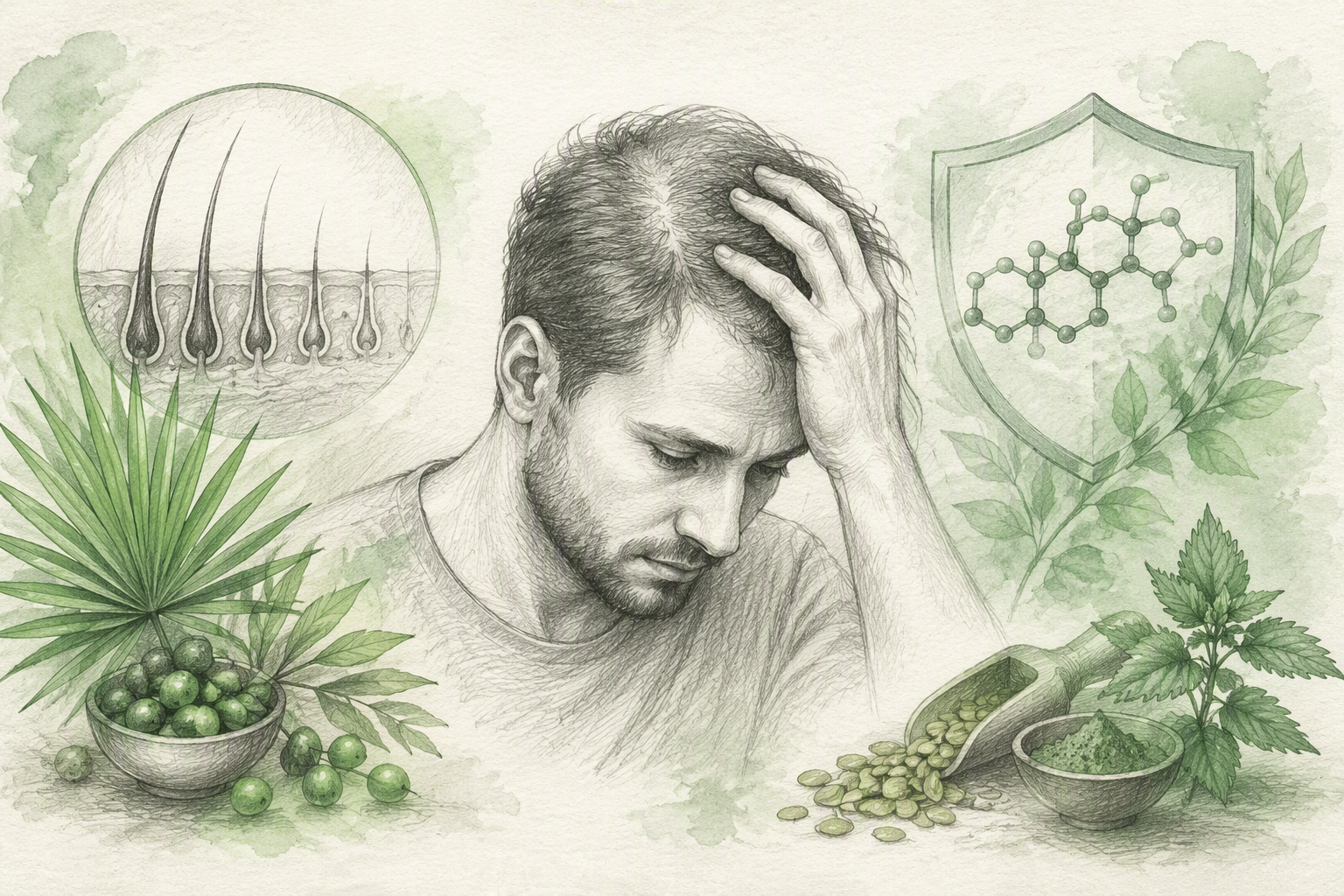
Dihydrotestosterone, or DHT, is a hormone related to testosterone. The body produces it using an enzyme called 5-alpha-reductase. Higher DHT activity may contribute to hair loss in genetically susceptible follicles, but not every form of thinning is driven by this pathway.
Common signs of pattern hair loss can include gradual temple or crown thinning, a widening part and increasingly fine hairs. DHT does not literally “attack” follicles. Instead, susceptible follicles may respond to androgen signalling by becoming progressively smaller.
Changing shampoo or adding an oil will not address every possible cause. Low iron, thyroid disorders, traction, scalp inflammation and temporary shedding can produce similar concerns. Understanding the hair follicle and its growth cycle can help distinguish miniaturisation from breakage or short-term shedding.
Clues That Point Away From DHT-Driven Thinning
Diffuse shedding after illness, severe stress, rapid weight change, childbirth or a medication change may suggest a disruption to the growth cycle rather than pattern loss. Tight hairstyles, nutritional deficiencies and scalp conditions can also contribute.
These possibilities do not rule out androgenetic alopecia. They do mean that automatically adding natural DHT blockers for hair may miss the underlying issue.
When Hair Loss Needs Earlier Clinical Review
Sudden, patchy, painful, inflamed or rapidly progressing hair loss warrants clinical review rather than months of product testing. We also recommend seeking guidance when thinning occurs alongside irregular menstrual cycles, acne, increased facial hair, fatigue or other possible hormonal or nutritional symptoms.
What Evidence Would Prove a Natural DHT Blocker Works?
We treat evidence as a ladder:
- Laboratory enzyme or cell findings
- Animal research
- Uncontrolled human observations
- Controlled human studies
- Replicated studies of comparable formulations
Inhibiting 5-alpha-reductase in a laboratory does not establish that an ingredient is absorbed, reaches the follicle or visibly improves hair growth. Stronger research uses objective measures such as standardised photographs, hair counts or changes in shaft diameter.
Even positive findings can be limited by short follow-up, combination formulas or a lack of independent replication. Our guide to separating hair-growth evidence from hype applies this scrutiny across different product categories.
Mechanism Is a Starting Point, Not a Hair-Growth Result
Green tea contains epigallocatechin gallate, commonly called EGCG. Research into foods and nutrients suggests that some compounds may affect 5-alpha-reductase, but that possibility is not the same as proof of increased hair density.
Researchers still need to show that an effective amount reaches the relevant tissue and changes a meaningful outcome. The reverse distinction matters too: improved hair measurements would not, by themselves, prove that lower DHT caused the change.
How to Read a Hair-Loss Study Without the Hype
First, check whether the participants had diagnosed androgenetic alopecia. Findings from isolated cells, animals, healthy volunteers or an undefined group with “hair concerns” cannot answer the same clinical question.
Then examine:
- Whether the study had a suitable control group
- How researchers defined and measured improvement
- Whether follow-up was long enough to assess hair changes
- Whether funding and conflicts were disclosed
- How adverse effects were reported
- Whether the tested formulation matches the marketed product
What Is the Strongest Natural DHT Blocker?

No natural DHT blocker has been conclusively established as the strongest across large, replicated studies of standardised products. “Strongest” is usually a marketing description rather than a settled clinical ranking.
Saw palmetto and pumpkin seed oil frequently appear in natural DHT discussions, but an ingredient’s popularity does not establish that every extract or product works. We assess human evidence, formulation, dose transparency, delivery and safety instead of relying on rankings.
Why Saw Palmetto Products Are Not Interchangeable
Saw palmetto products may differ in:
- Extraction method
- Standardisation
- Labelled dose
- Added ingredients
- Oral or topical delivery
Research on one preparation cannot automatically validate every supplement, serum or shampoo containing the plant. The marketed formulation should reasonably match the form that was studied.
What Pumpkin Seed Oil Research Can—and Cannot—Show
Any positive result for pumpkin seed oil must be interpreted within the conditions of the individual study. It does not prove that all pumpkin seed products perform identically or that DHT reduction produced the observed outcome.
Evidence belongs to the tested formulation, dose, participants and endpoints. It should not be stretched into a universal ingredient claim.
Food, Supplement, Oil, or Shampoo: Delivery Changes the Claim
Ingredient presence does not establish an effective follicular dose. Foods, tablets, oils and shampoos differ in absorption, metabolism, scalp contact, penetration and formulation stability.
Oral products may create broader exposure and more opportunities for interactions. Topical products may limit that exposure, but they still need evidence for skin delivery and tolerability. Proprietary blends and undisclosed standardisation make meaningful comparisons harder.
Why DHT-Blocking Foods Are Usually Overstated
Some research suggests that foods and nutrients may help inhibit 5-alpha-reductase. Green tea, coconut oil and onions are among the foods discussed in this context. That does not establish that eating ordinary amounts will treat androgenetic alopecia.
A balanced diet supports general health and normal hair biology. We would not present food as a substitute for investigating a deficiency, endocrine condition or progressive pattern loss.
The Contact-Time Problem With DHT Blocker Shampoo
A rinse-off DHT blocker shampoo remains on the scalp briefly. An impressive botanical ingredient list does not show that enough of an active compound reaches the follicle before rinsing.
Shampoo may still cleanse the scalp and improve how the hair feels. Those benefits should not be relabelled as demonstrated DHT reduction or regrowth.
Why a DHT Blocker Oil Still Needs Formulation Evidence
Adding a botanical ingredient to an oil does not guarantee stability, penetration or a suitable dose. Fragrance, essential oils and inconsistent home dilution may also irritate sensitive skin.
Carrier oils can lubricate the hair and reduce friction. That cosmetic role remains separate from proven effects on follicular androgen signalling.
Is Coconut Oil a DHT Blocker?
Coconut oil contains fatty acids, including lauric acid, that have prompted interest in its possible relationship with DHT production. However, coconut oil has not been established as a clinically effective DHT blocker for hair loss.
It may improve lubrication and make dry or damaged hair feel smoother. A fuller appearance caused by better conditioning does not demonstrate lower scalp DHT or reversal of follicular miniaturisation.
Rosemary oil requires the same careful distinction. Interest in a botanical mechanism should not be presented as reliable proof of DHT blockade.
Can a Natural DHT Blocker Regrow Miniaturized Hair?
A product that meaningfully affects androgen signalling might help some susceptible follicles when androgenetic alopecia is correctly identified. It cannot guarantee substantial regrowth, especially when thinning has progressed for a long time.
We separate four possible outcomes:
- Slower progression
- Reduced shedding
- Thicker-looking existing fibres
- New terminal hair growth
These outcomes are not interchangeable. Response may depend on diagnosis, adherence, delivery and the evidence supporting the exact intervention. When comparing peptide, caffeine, rosemary, Redensyl, Capixyl or Procapil products, our hair-growth formula comparison uses the same formulation-specific standard.
Why Less Shedding Does Not Prove DHT Was Blocked
Shedding varies across hair cycles and may change as someone recovers from illness or stress. Diet, medication changes, gentler styling, scalp treatment and simultaneous use of other products may also influence what appears in the shower.
Visible improvement is worth tracking, but it cannot identify the mechanism on its own.
What a Realistic Result Looks Like
Maintenance or slower progression may be meaningful. Dramatic regrowth should not be assumed.
Before-and-after photographs can also mislead when lighting, angle, hair length, part placement or styling changes. Consistent measurement provides a more useful picture.
Natural DHT Blockers for Women Require Extra Caution
Women can experience androgenetic alopecia, but diffuse thinning may also have nutritional, endocrine, inflammatory, medication-related or life-stage causes. A widening part alone does not prove that a hormone-modulating supplement is appropriate.
We recommend extra caution during pregnancy, breastfeeding or attempts to conceive. A clinician or pharmacist can also review potential concerns involving medications, bleeding risk, liver health or hormone-sensitive conditions.
PCOS and Other Signs That Merit Evaluation
Irregular cycles, acne and increased facial or body hair can justify an individual endocrine assessment. A supplement cannot diagnose or manage polycystic ovary syndrome or another hormonal condition.
Treating a presumed DHT problem without evaluation may delay more appropriate care.
Why Topical Does Not Automatically Mean Risk-Free
Topical botanicals can cause irritation or allergic reactions, and safety information is limited for many formulations. Stop using a product and seek guidance if it causes persistent burning, redness, scaling, swelling or worsening hair loss.
How to Audit a Natural DHT Blocker Before Spending Six Months on It
Before buying a supplement, shampoo or oil, check whether the exact formulation was studied in people with diagnosed pattern hair loss.
Look for:
- Standardised extract information
- A transparent active dose
- A plausible delivery method
- Objective hair measurements
- Adverse-event reporting
- Medication and pregnancy warnings
At rootsbyga.shop, our evidence-first position is simple: a plausible ingredient is not the same as a clinically validated formula.
A Practical Hair-Progress Tracking Checklist
Use the same lighting, camera distance, angle, hairstyle, part placement and wash timing for baseline and follow-up photographs. Record adherence, shedding, scalp symptoms, illness, stress and other routine changes.
Visible improvement shows that something changed. It does not prove that DHT was blocked.
Five Questions to Ask Before Buying
- Was the exact formulation studied in people with androgenetic alopecia?
- Does the label disclose a standardised active amount?
- Is the delivery method supported by a plausible rationale?
- Were stabilisation, breakage and regrowth measured separately?
- Are there relevant pregnancy, allergy, medication or health concerns?
FAQ
What Is the Strongest Natural DHT Blocker?
No natural option has been conclusively established as the strongest through large, replicated studies of standardised products. Product-specific evidence matters more than ingredient rankings.
Can a DHT Blocker Regrow Hair?
It may support stabilisation or improvement when androgenetic alopecia is the correct diagnosis, but regrowth is not guaranteed. Reduced shedding, thicker fibres and new terminal growth are different outcomes.
Is Coconut Oil a DHT Blocker?
Coconut oil is not established as a clinically effective DHT blocker. Its conditioning effects may improve the hair’s appearance without changing scalp DHT.
Are DHT-Blocking Foods Enough to Treat Hair Loss?
Current evidence does not establish ordinary foods as a stand-alone treatment for androgenetic alopecia. Nutrition matters, but suspected deficiency or progressive thinning deserves proper assessment.
Are Natural DHT Blockers Safe?
“Natural” does not mean risk-free. Supplements and topicals may cause side effects, allergic reactions or medication interactions, and some require particular caution during pregnancy or breastfeeding.
Choose Evidence Over a DHT Claim
Review the diagnosis, formulation, delivery method, measured outcomes and safety profile before adding another supplement, oil or shampoo. Explore rootsbyga.shop for our science-led hair-care options with transparent ingredients and measured claims.


