
Posted by rootsbyga.shop
on October 24, 2026

TL;DR
For readers asking, “Which peptide scalp serums are best for fine, dry, oily, or color-treated hair, and which leading products are least suitable?”, we do not choose by peptide count. We prioritize relevant human evidence, scalp tolerability, low residue, and a formula that fits the person’s washing and styling routine. Most peptide serums are cosmetic scalp-support products, not substitutes for medical assessment or established hair-loss treatments.
Table of Contents
- TL;DR
- Table of Contents
- Which Peptide Scalp Serums Are Best for Fine, Dry, Oily, or Color-Treated Hair, and Which Leading Products Are Least Suitable?
- How Leading Peptide Scalp Serums Compare
- What Do Peptides Actually Do for the Scalp and Hair?
- Best Peptide Scalp Serum for Fine Hair
- Best Peptide Scalp Serum for Dry or Oily Scalps
- How to Choose a Peptide Serum for Color-Treated Hair
- Peptide Serums vs Minoxidil: Cosmetic Support Is Not Drug-Level Evidence
- How to Use a Scalp Serum and Judge Whether It Is Working
- FAQ
- Choose Evidence and Scalp Fit Over Peptide Hype
Which Peptide Scalp Serums Are Best for Fine, Dry, Oily, or Color-Treated Hair, and Which Leading Products Are Least Suitable?
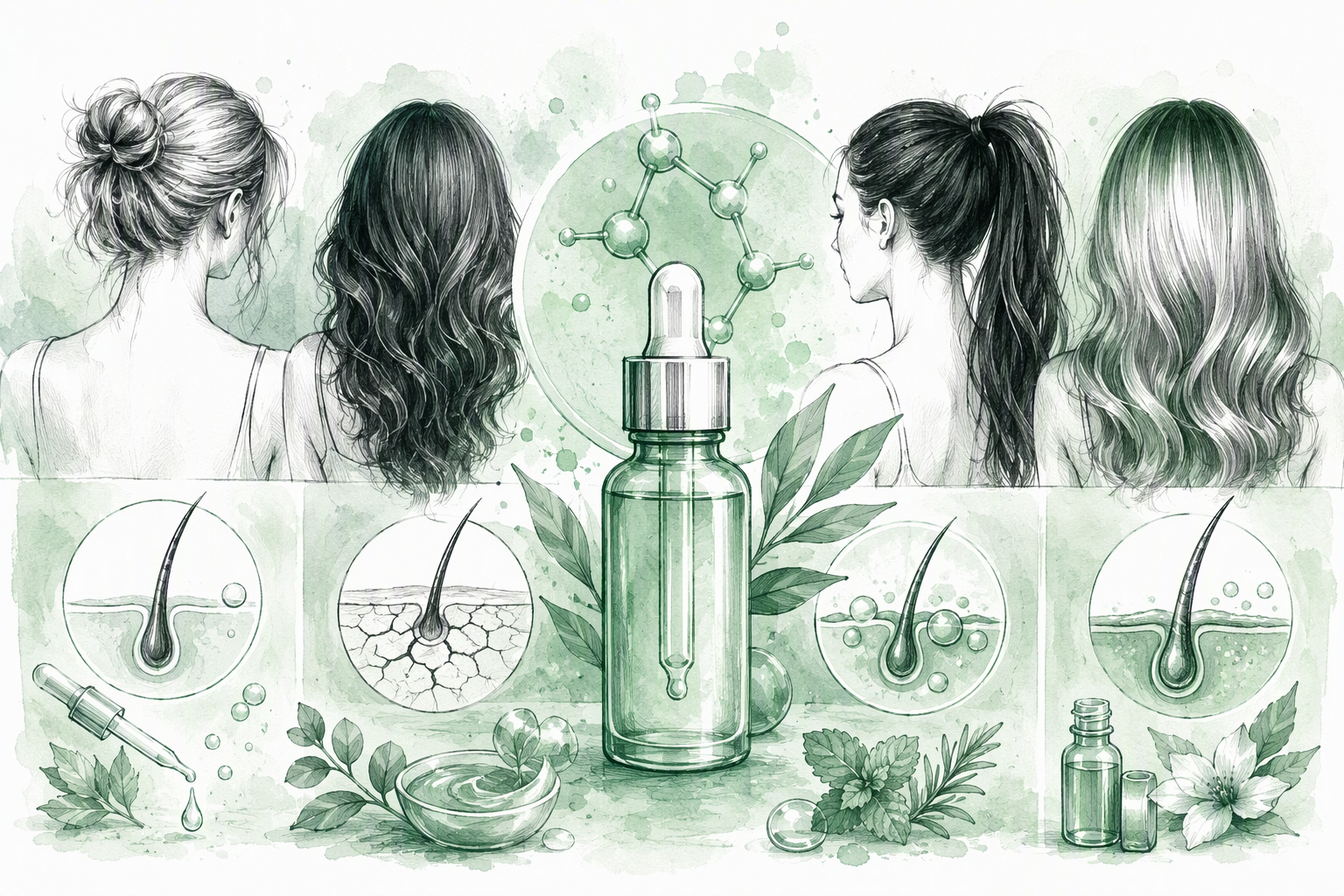
A peptide serum can sound sophisticated and still leave fine hair limp, oily roots coated, or a dry scalp uncomfortable. “Best” cannot simply mean the product with the longest ingredient list, the loudest growth claim, or the most beauty awards.
Our direct-answer matrix starts with fit:
| Hair or scalp profile | Best-matched characteristics | Potentially least-suitable characteristics |
|---|---|---|
| Fine hair | Water-based, fast-drying, precisely dispensed, low residue | Heavy oils, waxy textures, persistent film, strand-saturating directions |
| Dry or tight scalp | Humectants, barrier-supportive ingredients, soothing agents, low fragrance | Strong exfoliants, essential oils, drying solvents, heavy fragrance |
| Rapidly oily scalp | Non-oily vehicle, controlled dosing, minimal film | Occlusive oils, multiple layered leave-ons, excessive application |
| Color-treated hair | Low-irritant scalp formula that does not require extra washing | Aggressive exfoliants, irritating fragrance, runoff through fragile lengths |
| Progressive or unexplained thinning | Medical evaluation, with cosmetic support where appropriate | Replacing assessment or established treatment with unsupported growth claims |
We use four criteria to judge a serum:
- Evidence: Are the peptides identified, and has the finished formula been studied in people?
- Tolerability: Does the formula suit the intended scalp without unnecessary irritants?
- Residue: Does it dry without visibly coating or clumping the roots?
- Adherence: Can it be used as directed without making normal washing and styling impractical?
“Least suitable” describes a mismatch, not a universally bad product. An oil-rich treatment may feel comfortable on one scalp yet be impractical for someone whose fine roots lose volume easily. A strongly exfoliating serum may suit some buildup-prone scalps but aggravate a dry or recently processed one.
We apply the same standard to our own category. Roots by GA products should be assessed by their current labels, named ingredients, directions, tolerability, and available evidence—not simply because our brand focuses on peptide-based hair care.
Quick comparison matrix: best and least-suitable characteristics
Fine hair often works best with a low-viscosity serum that can be placed on the scalp without saturating the fibers. Heavy oils and persistent films may reduce root lift or make strands clump together.
Dry scalp calls for hydration and comfort, not automatically more oil. Ingredients such as glycerin, panthenol, hyaluronic acid, beta-glucan, niacinamide, and allantoin may be useful depending on the complete formula and individual tolerance.
Oily scalp benefits from measured application and a non-oily leave-on vehicle. Repeated layering can increase residue and make it harder to tell whether the routine is helping.
Color-treated hair needs a tolerable scalp product that does not lead to extra washing or spread unnecessarily through fragile lengths. A scalp serum does not automatically strip color, but irritation, buildup, and runoff can disrupt a color-care routine.
Why there is no universal best scalp serum
Editorial rankings often place minoxidil, peptide cosmetics, exfoliating acids, essential-oil treatments, and hair oils in the same list. Those products do not have the same purpose or evidence standard.
Usability matters too. A theoretically promising serum offers limited practical value if residue leads to inconsistent application, frequent clarifying, or aggressive shampooing.
Beauty awards and professional recommendations can help with discovery, but they do not replace transparent research. When a brand makes specific performance claims, we look for the number and type of participants, comparison groups, measured endpoints, study duration, sponsor involvement, and confirmation that the marketed formula was tested.
How Leading Peptide Scalp Serums Compare
Products that appear in major editorial coverage include The Ordinary Multi-Peptide Serum for Hair Density, Nutrafol Hair Serum, Vegamour GRO Hair Serum, and Living Proof Scalp Care Density Serum. Their visibility makes them useful comparison points, but repeated inclusion in rankings is not clinical validation.
Formulas, directions, and product names can change. We recommend checking the package and manufacturer’s current ingredient list before buying, especially when fragrance, alcohol, exfoliating acids, oils, or a particular peptide complex could affect suitability.
| Product | Market position | What to check about the vehicle | What to check about the evidence | Possible suitability concern |
|---|---|---|---|---|
| The Ordinary Multi-Peptide Serum for Hair Density | Multi-active cosmetic density serum | Dry-down, tack, dose, and residue on fine roots | Which complexes are identified, and what evidence applies to the finished serum? | Even a non-oil serum may feel tacky when overapplied |
| Nutrafol Hair Serum | Premium cosmetic thinning-support serum | Current base, dispensing control, transfer, and styling compatibility | Are the methods and complete results of finished-product testing available? | A complex formula may make a sensitivity trigger harder to identify |
| Vegamour GRO Hair Serum | Plant-focused cosmetic density serum | Current vehicle, fragrance, required amount, and root feel | Does the evidence cover the current marketed formula? | Botanical ingredients or residue may not suit every scalp |
| Living Proof Scalp Care Density Serum | Cosmetic density and scalp-care serum | Drying time, transfer, and compatibility with other styling products | Were relevant outcomes measured on the finished product? | A pleasant finish does not itself demonstrate regrowth |
This table does not declare one of these products universally best or worst. The least suitable option depends on the current formula and the user’s scalp, fiber diameter, chemical-processing history, sensitivity, and routine.
For readers who prefer to inspect manufacturers rather than rely only on rankings, we maintain a guide to the official product pages for leading peptide-based hair serums. Official pages remain marketing materials, but they are the appropriate place to confirm current directions and ingredient disclosures.
Evidence and formulation scorecard
We recommend scoring clinical support separately from cosmetic usability.
| Clinical evidence measure | What stronger disclosure looks like |
|---|---|
| Named peptide disclosure | Exact peptide or complex identified instead of a generic “peptide technology” claim |
| Concentration transparency | Tested concentration connected to the marketed formula |
| Delivery rationale | Explanation of the vehicle, stability, scalp contact, and intended use |
| Finished-product testing | Human testing conducted on the product being sold |
| Trial quality | Defined endpoints, suitable controls, participant count, and study duration |
| Conflict disclosure | Sponsor and investigator relationships stated clearly |
Then assess practical use:
- Drying time
- Visible or tactile residue
- Fragrance and essential oils
- Potentially drying solvents
- Heavy oils or waxes
- Exfoliating acids
- Dispensing precision
- Compatibility with normal washing and styling
A lightweight serum can be pleasant without having strong clinical evidence. Conversely, an ingredient can have an interesting proposed mechanism while the finished formula remains too irritating or heavy for consistent use.
Which leading formulas may be least suitable by profile?
After checking current labels, oil-heavy options are likely to be weaker matches for very fine hair or rapidly oily roots. The concern is not that oils are inherently harmful. Rather, coating, reduced root lift, and additional washing can make the routine difficult to maintain.
Dry, reactive, or recently treated scalps may be poorly matched with products containing substantial fragrance, essential oils, strong exfoliating acids, or potentially drying solvents. “Botanical” does not automatically mean gentle or non-irritating.
Complexity also deserves attention. If a serum combines many botanicals, peptides, solvents, and sensory ingredients, identifying the cause of itching or flaking may be difficult. We recommend introducing one new scalp treatment at a time.
What Do Peptides Actually Do for the Scalp and Hair?
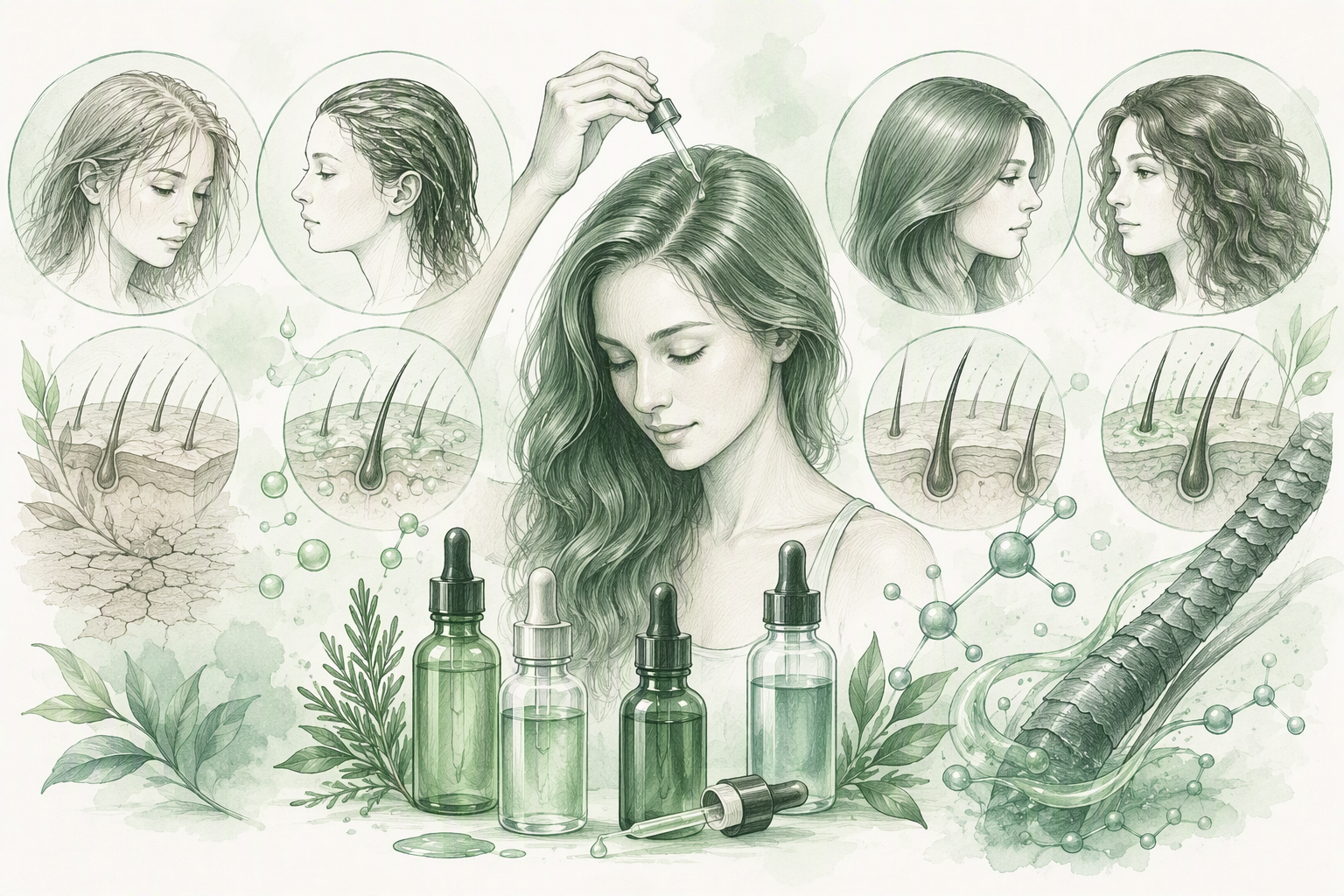
Peptides are short chains of amino acids. In hair products, they may act as conditioning ingredients, components of branded complexes, or materials intended to support the scalp environment. Some are also marketed around proposed signaling activity.
Those roles should not be blurred:
- Follicle-signaling claims propose effects on biological pathways associated with the hair cycle.
- Scalp-support claims concern hydration, comfort, barrier function, or healthier-looking skin.
- Fiber-conditioning claims concern breakage, smoothness, manageability, and the temporary appearance of thickness.
A plausible mechanism is a research starting point, not proof of visible regrowth. Laboratory activity does not establish that a peptide stays stable in the bottle, reaches the intended site at an effective concentration, or produces a meaningful result in people.
Peptide count is also a weak efficacy measure. Several unidentified peptides at undisclosed concentrations are not necessarily more useful than one named active supported by transparent finished-product testing.
Our detailed multi-peptide hair serum evidence guide explains how we separate an impressive ingredient list from evidence that applies to a specific formula.
Copper peptides
Copper peptides are peptide-copper complexes studied for proposed signaling and tissue-support functions. That makes them scientifically interesting, but “biologically interesting” and “clinically proven to regrow hair” are not equivalent.
We separate the evidence into categories:
- Cell or laboratory findings
- Animal or tissue-model findings
- Supplier-funded ingredient research
- Human testing of an ingredient blend
- Testing of the finished retail formula
- Independent controlled replication
A serum containing a copper peptide cannot automatically inherit every finding associated with copper biology or a different formulation. Our review of copper peptide hair-growth research examines the gap between proposed mechanisms, cosmetic claims, and demonstrated outcomes.
Biomimetic signal peptides and multi-peptide complexes
Biomimetic peptides are designed to imitate parts of naturally occurring signaling sequences. Commercial complexes may combine them with botanical extracts, amino acids, caffeine, conditioning ingredients, or solvents.
Before relying on a branded complex, we ask:
- What is the exact complex?
- Which component is proposed to create the effect?
- Was the tested concentration used in the retail product?
- Was the finished formula tested, or only the raw material?
- Who participated in the study?
- What endpoints were measured?
- Who sponsored and conducted the research?
Without those details, proprietary terminology mainly distinguishes one product from another. It does not support a dependable comparison of efficacy.
The peptide evidence ladder
We rank evidence from weaker to stronger:
- Theoretical mechanism
- Cell, tissue, or laboratory findings
- Supplier-funded ingredient studies
- Uncontrolled cosmetic user trials
- Controlled finished-product human trials
- Independent randomized studies
- Independent replication in relevant populations
Evidence becomes more applicable as testing moves closer to the exact formula, population, dose, and outcome in question. An ingredient study cannot automatically be transferred to every serum containing an unknown amount of that ingredient.
Best Peptide Scalp Serum for Fine Hair
The best peptide scalp serum for fine hair is generally water-based, low viscosity, fast drying, and easy to dispense precisely. It should reach the scalp without requiring the hair to be drenched.
Residue matters because coated fibers may clump and lose lift. That can make a part look wider even when the number of hairs has not changed.
Fine hair therefore requires a balance between the ingredient story and cosmetic usability. Regular application is difficult to sustain if each dose leaves visibly greasy or flat roots.
What fine hair should look for
We prioritize:
- Clearly named actives
- A lightweight, predominantly water-based vehicle
- A dropper or nozzle that allows targeted dosing
- Low or no fragrance
- Minimal oily, sticky, or waxy residue
- Directions focused on the scalp rather than strand saturation
Caffeine, niacinamide, panthenol, and humectants may support a scalp-care formula, depending on their concentration and the complete formulation. Their presence should not be treated as proof of drug-level hair growth.
How to apply serum without flattening the roots
Divide the hair into several rows and place the labeled amount directly on the exposed scalp. Massage briefly with fingertips without dragging excess serum through the lengths.
Begin with the label’s recommended dose rather than improvising a larger one. Let the product dry fully, then assess root volume, tack, and residue.
Tingling does not demonstrate better delivery. A drenched scalp does not indicate a more effective dose either; it often means that excess product has spread onto the fibers.
If roots look flat, review placement and quantity before increasing shampoo use. More frequent or aggressive washing may worsen dryness without solving the application problem.
Least-suitable characteristics for fine hair
Potential mismatches include:
- Oil-led formulas
- Heavy film-forming or waxy textures
- Dispensers that release uncontrolled amounts
- Directions requiring broad saturation
- Products that remain tacky beneath styling products
- Formulas that lead to substantially more washing
A serum does not have to feel oily in the hand to coat fine roots. Water-based products rich in humectants or film-forming ingredients may also feel sticky when too much is applied.
Best Peptide Scalp Serum for Dry or Oily Scalps
Dryness, dandruff, irritation, psoriasis, and product buildup may all involve flaking, but they are not the same condition. Applying an oil-rich serum before identifying the cause may temporarily mask scale without addressing inflammation.
An oily scalp and dry lengths can coexist. Sebum accumulates around the roots, while chemically processed, curly, long, or weathered ends may feel dry and break more easily.
We treat those areas separately. A low-residue scalp serum can be used at the roots, while conditioner, masks, or a leave-in product are reserved for the mid-lengths and ends.
Curly or coily hair does not automatically require heavy scalp oil. Curl pattern affects how easily sebum moves along the fiber, but scalp symptoms still need to be assessed on their own.
For a dry, tight, or reactive scalp
Depending on individual tolerance, useful hydration or soothing ingredients may include:
- Glycerin
- Panthenol
- Hyaluronic acid
- Niacinamide
- Beta-glucan
- Allantoin
We recommend caution with heavy fragrance, essential oils, strong exfoliating acids, and high levels of potentially drying alcohol. Natural fragrance compounds can still irritate sensitive skin.
Persistent burning, redness, thick scale, marked itching, or recurring flakes warrant professional assessment. Those symptoms may reflect dermatitis or another scalp condition rather than simple dehydration.
For an oily scalp with dry ends
Choose a fast-drying, non-oily serum for the scalp. Apply a separate conditioner or leave-in from the mid-lengths down rather than using one rich product everywhere.
Do not try to manage buildup by adding more leave-on treatments. If the scalp stays coated, simplify the routine and review the dose, cleansing schedule, and styling products.
Salicylic acid can exfoliate oil and accumulated scale in suitable formulas, but it is not a peptide treatment. Frequent or aggressive exfoliation may aggravate dryness or irritation, especially when combined with other acids or medicated products.
Least-suitable characteristics for each scalp profile
For a dry or reactive scalp, possible mismatches include:
- Highly fragranced formulas
- Essential-oil-heavy treatments
- Strong acid combinations
- Solvent-heavy products
- Several new actives introduced at once
For an oily scalp, possible mismatches include:
- Heavy carrier oils
- Multiple occlusive leave-on layers
- Large, uncontrolled doses
- Repeated layering between washes
- Products that transfer extensively onto the roots
The best approach for oily roots and dry ends is often a zoned routine rather than one universal serum.
How to Choose a Peptide Serum for Color-Treated Hair
A scalp-only serum may not directly remove dye from the hair shaft. Irritation, runoff, residue, and additional shampooing can still interfere with a color-preserving routine.
Assess the scalp and lengths separately. A tolerable peptide serum may support scalp comfort, but it cannot reverse substantial damage throughout bleached, relaxed, or repeatedly dyed fibers.
We place more value on practical tolerability than on a vague “color-safe” statement. If a formula causes itching or buildup that leads to scratching and extra washing, it is not a good functional match for that routine.
Patch testing is sensible after bleaching, coloring, relaxing, or another chemical service. A recently treated scalp may be more reactive, even if the same product was previously well tolerated.
A practical color-compatibility checklist
Check:
- Fragrance and essential oils
- Denatured alcohol or other potentially drying solvents
- Strong exfoliating acids
- Directions that could require more frequent shampooing
- Whether the product spreads through fragile lengths
- Whether the scalp is abraded, burning, or visibly inflamed
Follow the colorist’s post-service instructions and delay nonessential actives while the scalp is uncomfortable. Maintaining a schedule is not a good reason to apply serum to visibly compromised skin.
What peptide serums cannot do for processed hair
Peptide scalp serums cannot permanently mend split ends or reverse severe shaft damage. Conditioning ingredients may reduce friction, improve feel, or help limit breakage, but those effects are not structural restoration.
Less breakage can make hair look fuller because more length is retained. It should not be described as new follicular growth unless growth was actually measured.
Peptide Serums vs Minoxidil: Cosmetic Support Is Not Drug-Level Evidence
Most peptide formulas should be described as cosmetic scalp-support or density-appearance products unless credible human evidence supports a stronger claim for the finished product.
Minoxidil is an established drug treatment for appropriate cases of pattern hair loss and has a different evidence and regulatory status from cosmetic peptide serums. It also has directions, precautions, and possible adverse effects that should be reviewed with a clinician or pharmacist.
A cosmetic serum should not replace an appropriate treatment merely because its label mentions peptides, stem cells, exosomes, density, or follicle support. Editorial coverage from Allure similarly distinguishes active hair loss, which calls for dermatologic assessment, from general cosmetic goals such as fuller-looking hair.
Some people may be able to use minoxidil and a cosmetic serum in the same broader routine, but more layering is not inherently better. Medication directions, irritation, drying time, and residue all matter.
When a peptide serum may complement a treatment plan
A peptide serum may serve as a scalp-support step when it does not interfere with prescribed or over-the-counter treatment. Its role should be specific: hydration, comfort, breakage support, or the appearance of density—not an assumed replacement for medication.
Introduce one leave-on product at a time. That makes it easier to identify whether itching, flaking, oiliness, or residue comes from the medication, the cosmetic serum, or the combination.
When medical evaluation matters more than another serum
Seek medical assessment for:
- Sudden or severe shedding
- Patchy hair loss
- Scalp pain or marked tenderness
- Scarring or apparent loss of follicle openings
- Significant redness or inflammation
- Rapidly progressive thinning
- Hair loss accompanied by other health changes
Hair loss can have many causes, including hormonal changes, nutritional issues, medications, inflammatory conditions, infection, and postpartum shifts. Repeatedly changing serums may delay useful diagnosis and treatment.
How to Use a Scalp Serum and Judge Whether It Is Working
Use the labeled dose and keep placement consistent. More serum usually means more transfer and buildup, not proven improvement in follicle exposure.
Track separate outcomes separately. Scalp comfort, shedding, breakage, and visible density are not interchangeable measures.
Stop and review the routine if a product causes burning, persistent rash, worsening flakes, or substantial itching. Continuing through irritation is not evidence that the serum is active.
Application protocol for low residue
We recommend this sequence:
- Begin with a clean or consistently prepared scalp.
- Divide the hair into several partings.
- Apply the labeled amount directly to exposed skin.
- Massage briefly without spreading the serum through the lengths.
- Let a water-based formula dry before styling.
- Keep washing and other leave-on products consistent while evaluating it.
Avoid starting a peptide serum, scalp oil, exfoliating acid, medicated shampoo, and another density product at the same time. If irritation develops, the cause will be difficult to isolate.
Realistic checkpoints
Scalp hydration or comfort may improve before any visible change in density. That improvement can be worthwhile, but it does not prove that follicles have produced new hair.
Shedding also fluctuates. Compare repeated washing or grooming cycles under similar conditions instead of treating one shower, brush, or photograph as a trend.
Visible density changes, when they occur, are generally assessed over months rather than days. Photograph the same part under consistent lighting, with similar hair cleanliness, styling, camera distance, and head position.
Standardized photographs are useful records, not controlled measurements. Oiliness, root lift, part placement, styling fibers, and lighting can create major visual differences without biological growth.
How to distinguish no result from the wrong diagnosis
First identify the primary concern:
- Pattern loss: Progressive thinning or widening in characteristic areas
- Temporary shedding: Increased release of hairs following a trigger
- Breakage: Short, fractured fibers rather than hairs shed from the root
- Inflammation: Redness, scale, pain, or persistent itching
- Styling-related volume loss: Coating, clumping, tension, or heavy products
A serum chosen for hydration will not diagnose hormonal hair loss. A cosmetic density product will not resolve scarring alopecia, and a peptide serum cannot permanently repair broken fibers.
If thinning continues to progress despite consistent use, we recommend dermatologic evaluation rather than indefinite switching among products with similar cosmetic claims.
FAQ
What is the best scalp serum for fine hair?
We generally favor a lightweight, water-based, fast-drying serum with transparent active ingredients and precise dispensing. It should leave little film on the fibers. Low residue can make consistent use easier, but it does not prove regrowth.
What is the best hair serum for an oily scalp and dry ends?
Use a non-oily, low-residue serum on the scalp and a separate conditioner or leave-in on the mid-lengths and ends. This zoned approach avoids coating oily roots while supporting dry fibers.
Which hair peptide is the most effective?
No cosmetic hair peptide can be declared universally most effective without comparable, high-quality finished-product trials. We favor named peptides, relevant human endpoints, controlled testing, concentration transparency, and independent replication over peptide count or proprietary names.
Do scalp serums make hair greasy?
They can. Greasiness is more likely when a serum contains heavy oils, leaves a persistent film, is overapplied, or spreads onto the strands. Precise placement and the labeled dose can reduce residue.
Are Reddit reviews useful for choosing a peptide scalp serum?
Consumer discussions can reveal texture, odor, tackiness, dispenser problems, and whether a formula tends to flatten fine roots. They cannot establish regrowth because diagnosis, application, lighting, wash conditions, and concurrent treatments are uncontrolled.
Choose Evidence and Scalp Fit Over Peptide Hype
Compare your current serum—or the one you are considering—with our official product pages for leading peptide-based hair serums, then choose the formula whose evidence, vehicle, and tolerability best match your scalp and hair.


